Of course, I do not mean that God has abandoned His Church. Jesus Christ promised that the gates of hell would not prevail against her. Nor do I mean that there are not countless faithful Catholics, holy priests, religious, bishops, fathers and mothers who love God deeply and are striving every day to live the Catholic faith.
I mean something different.
I am asking whether we have gradually constructed a way of thinking about the Church – a way of governing her, speaking about her, worshipping within her, and determining her priorities – that increasingly functions as though the supernatural were no longer the central reality. Because Catholicism is supernatural or it is nothing.
Think about the Catholic faith our ancestors knew. They believed in heaven. They believed in hell. They believed in angels and demons. They believed that Satan was real and that spiritual warfare was real. They believed in miracles. They believed in Our Lady and the intercession of the saints. They believed that sin could destroy the life of grace in the soul. They believed that Confession could restore that life. They believed that when a priest pronounced the words of consecration at the altar, bread and wine truly became the Body, Blood, Soul and Divinity of Jesus Christ. They believed eternity was real.
And because they believed these things, they lived differently. They built magnificent churches because God was there. They knelt because God was there. They whispered in church because God was there. They went to Confession because sin was real. They fasted because penance was real. They prayed for the dead because purgatory was real. They prayed the Rosary because they believed the Mother of God actually heard them. They spent an hour before the Blessed Sacrament because they believed they were sitting before Jesus Christ.
Certainly Catholics of previous generations had their sins and failures. There was never a golden age in which everyone was holy. But there was a supernatural framework within which Catholic life was understood. And I fear that we have been dismantling that framework for decades.
Listen to much of the language surrounding the Church today. We hear constantly about listening. Dialogue. Accompaniment. Inclusion. Encounter. Synodality. Walking together. Human fraternity.
These things can have legitimate meanings. Listening can be good. Dialogue can be necessary. Certainly we should accompany people with charity and compassion.
But we have to ask: “Where is God in all of this?” In all our talking to one another, are we still talking to Him?
And when we listen, are we listening first to the voice of God – or are we listening in order to determine whether what God has already revealed should somehow be reconsidered? There is an enormous difference.
The Church did not receive the Gospel from a focus group. Truth was not given to us by consensus. Jesus Christ did not tell the Apostles to go into the world and discover what humanity believed. He told them: “Going therefore, teach ye all nations.”
The Church was given something. A deposit of faith. A revelation. A truth that comes from God. Our task is not to reinvent it. Our task is to receive it, guard it, live it and hand it on.
More than a century ago, Pope St. Pius X saw a danger developing within Catholic thought. He called it modernism. He understood that modernism was not merely one isolated heresy among many. It attacked something deeper – the foundations by which revealed truth itself is known and received.
If religious truth ultimately becomes dependent upon human experience, consciousness or historical development, then man gradually becomes the judge of revelation instead of revelation becoming the judge of man.
This is why St. Pius X fought modernism so vigorously. It is also why the Church once required the Oath Against Modernism. And it is why men such as Archbishop Marcel Lefebvre later warned that modernism had not disappeared.
One does not have to agree with every decision Archbishop Lefebvre made to recognize the seriousness of the question he raised. What happens when the Church begins accommodating herself to the spirit of the age? What happens when the desire to be accepted by modern man becomes stronger than the desire to convert modern man?
Dietrich von Hildebrand identified the problem with remarkable clarity when he warned against placing unity above truth. Because ultimately the primacy of truth is the primacy of God. That is the heart of the matter.
Once the supernatural begins disappearing, the consequences spread everywhere. Consider sin. If heaven and hell are realities, then mortal sin is enormously serious. If a soul can be separated from sanctifying grace, then warning someone about sin is not hateful. It is loving.
If I saw someone walking toward the edge of a cliff, would compassion require me to remain silent because shouting might make him uncomfortable? Of course not. I would shout precisely because I loved him.
For two thousand years, the Church has called men and women to repentance because she believed something eternal was at stake. But what happens when we lose that supernatural perspective?
Sin gradually becomes something else. Instead of asking whether an action conforms to the law of God, we begin asking whether a person feels welcomed. Teachings concerning marriage, sexuality and the human person become increasingly difficult to proclaim because the culture has rejected them.
The Church must always receive every person with charity. Every human being possesses dignity. No Catholic should treat another person with hatred or contempt. But charity cannot mean telling someone that something God has called sinful is no longer sinful. That isn’t mercy. Because if sin is not real, repentance is unnecessary. If repentance is unnecessary, forgiveness becomes unnecessary. And if forgiveness is unnecessary, eventually the Cross itself becomes unnecessary.
Why would humanity need a Savior if humanity’s fundamental problem is simply that we haven’t sufficiently listened to one another?
The same problem can appear in our relationship with other religions. We should treat people of every religion with dignity. We should work for peace. We should oppose hatred and persecution. But we must never forget why the Church exists.
Jesus Christ is not simply one religious teacher among many. He is the Son of God. He said: “I am the way, and the truth, and the life. No man cometh to the Father, but by me.”
Those words cannot simply be placed alongside every other religious claim as though all paths ultimately amount to the same thing. If Jesus Christ is truly God, then evangelization matters. Conversion matters. Baptism matters. Mission matters. Salvation matters.
Again, the supernatural changes everything.
And this brings us to bishops.
I say this as a bishop myself, and therefore I say it first to myself.
Every bishop will stand before Jesus Christ. We will not stand before a committee. We will not stand before the media. We will not stand before politicians, donors, consultants or public opinion. We will stand before Christ. And we will answer for the souls entrusted to us.
The bishop is not simply an administrator. He is not a branch manager of an international religious organization.
Lumen Gentium itself reminds us that bishops are not to be regarded merely as vicars of the Roman Pontiff. Bishops are vicars and ambassadors of Christ. That should make every bishop tremble.
There have been moments throughout Church history when bishops had to stand against powerful currents of error. Think of St. Athanasius. Think of St. John Fisher. Think of the countless bishops who suffered exile, imprisonment and even death rather than compromise the faith.
Where does that courage come from? It comes from supernatural faith.
If this world is everything, protect your position. Protect your reputation. Protect your career. Avoid controversy. Remain comfortable.
But if eternity is real, everything changes. Then losing an office is nothing. Losing popularity is nothing. Losing the approval of powerful people is nothing.
The only question that ultimately matters is: “Have I been faithful to Jesus Christ?”
The Church has also become strangely uncomfortable with condemnation. We prefer dialogue. And again, dialogue has its place. But sometimes a shepherd must say no.
This is true in every family. A loving father doesn’t affirm everything his children decide to do. Sometimes love requires him to say: No. That will hurt you.
The Church historically understood doctrinal condemnation in much the same way. Anathemas were not supposed to be expressions of hatred. They established boundaries because the Church believed error could destroy souls. That is why the concept sometimes called the “charitable anathema” deserves reflection.
If heresy can lead souls away from Christ, correcting it is charity. If mortal sin can separate a soul from God, warning against it is charity. If receiving Holy Communion unworthily can be sacrilege, protecting the Eucharist is charity.
Perhaps one reason we have become so reluctant to condemn error is not that we have discovered a greater charity than the saints possessed. Perhaps instead we have lost confidence that error has eternal consequences. And if that is true, we are once again confronting the same problem: the loss of the supernatural.
But I do not want this message to be one of despair. Because something else is happening. Everywhere I go, I encounter Catholics who are hungry. Not hungry for another program. Not hungry for another committee. Not hungry for another listening session. They are hungry for God.
Young Catholics are discovering Eucharistic adoration. Families are rediscovering the Rosary. People are reading the lives of the saints. They are learning about Eucharistic miracles. They are discovering fasting and traditional devotions. Many are drawn to the beauty and reverence of the traditional Latin Mass.
Why?
I don’t believe it is simply nostalgia.
Many of these young people have no memory of the old Catholic world. They never lived it. What they are searching for is transcendence. They are searching for something that does not come from themselves. They want mystery. They want reverence. They want sacrifice. They want truth.
Ultimately, they want God.
And perhaps they understand something that ecclesial planners have forgotten: If the Church offers the world only what the world can already provide, the world has no need of us. The world already has humanitarian organizations. It has social movements. It has conferences. It has therapists. It has community organizations. It has political movements. It has endless opportunities for dialogue.
What the world cannot give itself is supernatural grace. The world cannot absolve one sin. The world cannot consecrate the Eucharist. The world cannot give us the Body and Blood of Christ. The world cannot open heaven.
Only Christ can save. And Christ entrusted His saving mission to His Church.
So what is the answer? It is not bitterness. It is not anger. It is not another Catholic faction. And fundamentally, it is not that we need a harsher Church.
We need a Church that believes again.
A Church that believes Jesus Christ is truly present in the tabernacle. A Church that believes Confession raises spiritually dead souls to life. A Church that believes Our Lady and the saints really intercede for us. A Church that believes angels are real. A Church that believes demons are real. A Church that believes miracles still happen. A Church that believes Scripture is the Word of God. A Church that believes sin is real. A Church that believes mercy is real. A Church that believes judgment is real. A Church that believes heaven is worth sacrificing everything to attain.
And a Church that therefore possesses enough courage to tell the truth when telling the truth costs us something.
Sacred Scripture gives us words desperately needed in our age: “Do manfully and be of good heart: fear not, nor be ye dismayed at their sight: for the Lord thy God he himself is thy leader, and will not leave thee nor forsake thee” (Deuteronomy 31:6).
Why are we afraid? Why should a bishop be afraid to proclaim what Christ has revealed? Why should a priest be afraid to preach about sin? Why should parents be afraid to teach their children that Catholic truth is actually true? Why should Catholics be embarrassed to speak about miracles? Why should we be embarrassed by the saints? Why should we whisper about the devil when Scripture speaks plainly about spiritual warfare? Why should we apologize for believing that Jesus Christ is the Savior of the world?
St. Paul tells us: “For our wrestling is not against flesh and blood; but against principalities and powers, against the rulers of the world of this darkness, against the spirits of wickedness in the high places” (Ephesians 6:12).
Either that is true or it isn’t.
If it is true, then perhaps it is time for Catholics to begin living as though it is true.
Perhaps the deepest crisis in Catholicism, then, isn’t ultimately the liturgical crisis. It isn’t the sexual crisis. It isn’t the crisis of vocations. It isn’t the crisis of episcopal leadership. It isn’t even the crisis of doctrine.
Underneath all of these may be something still deeper: A crisis of faith in the supernatural.
Do we really believe God has spoken? Do we believe His truth remains true when the world rejects it? Do we believe eternity is real? Do we believe souls can be lost? Do we believe souls can be saved? Do we believe Jesus Christ is God?
Because if we really believe these things, our churches should look different. Our preaching should sound different. Our worship should look different. Our families should live differently. And our bishops should lead differently.
We can have our synods. We can have our committees. We can write our documents. We can hold our meetings. We can dialogue. We can listen. We can accompany. But if somewhere along the way God becomes secondary, what exactly are we walking together toward?
The Church does not need to become more like the world in order to save the world. She needs to become more completely what Jesus Christ established her to be.
We need confessionals filled again. We need families praying the Rosary. We need fasting. We need penance. We need reverence before the Holy Eucharist. We need priests preaching eternal truths. We need bishops willing to suffer for those truths. We need churches in which a person walking through the doors immediately senses: God is here.
The frightening thing is not simply that the world has learned to live without God. Much of the world clearly has. The frightening possibility is that the Church could learn to function without Him.
A Church filled with activity. A Church filled with conversation. A Church filled with programs and processes and meetings and documents. And yet a Church in which the supernatural God has somehow been pushed quietly to the margins.
Brothers and sisters, we cannot allow that to happen. The answer is not another program. The answer is Jesus Christ.
Return Him to the center. Return to His Eucharistic Heart. Return to Confession. Return to prayer. Return to Sacred Scripture. Return to the faith handed down to us. Return to Our Lady. Return to the saints. Return to sacrifice. Return to reverence. Return to the supernatural.
And do not be afraid. Because the world does not need a Church without God. The world desperately needs the Church of Jesus Christ – the Church of the living God.
May Our Lord strengthen you, may Our Lady keep you beneath her mantle, and may you remain steadfast in the true faith, whatever trials may come.
And may Almighty God bless you, the Father, and the Son, and the Holy Ghost.
Amen.
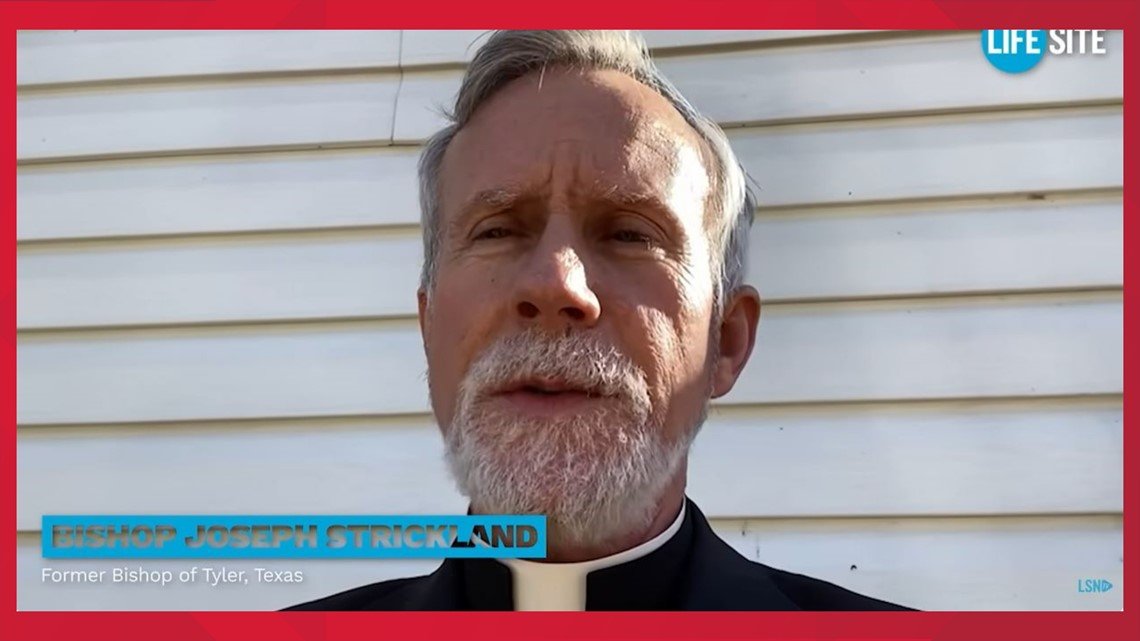
Bishop Joseph E. Strickland
Bishop Emeritus