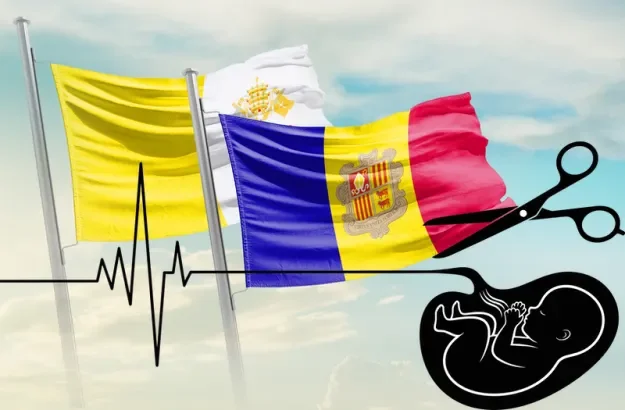
The Principality of Andorra is one of the smallest nations on earth, a micro-state situated in the Pyrenean Mountains between Spain and France. It is one of the few Western countries in which abortion is still illegal and punishable by law. Unfortunately, that is about to change.
Andorra is not a monarchy but a diarchy. This means that there are two heads of state, who exercise authority conjointly over the country. The two Andorran so-called “co-princes” are the president of France and the Roman Catholic bishop of the diocese of Urgell (Spain), ex officio. The French president at present is Emmanuel Macron, and the Novus Ordo bishop currently occupying the diocese of Urgell is Josep-Lluís Serrano Pentinat (b. 1977).
Last May, we disagreed with Vatican reporter Serre Verweij for his unduly optimistic assessment of Leo XIV’s first year at the helm of the Vatican II Church. Regarding Andorra in particular, Verweij had written:
Even more impressive is the fact that Pope Leo’s intervention on abortion apparently killed a secret, unofficial agreement that the government of Andorra had been working to secure under Francis — one under which the Catholic Church would tacitly go along with the decriminalization, but not the legalization, of abortion.
Now, it seems, that narrative is falling apart.
Last week, the traditionalist (but not sedevacantist) platform InfoVaticana released an alarming article, based on most recent developments and reports published last year by the Andorran news site La Veu Lliure.
Aug. 11, 2026: Andorra prepares for September the decriminalization of abortion after years of talks with the Vatican (InfoVaticana)
Less than a year ago, some English-language Novus Ordo news sites had reported on the matter as well, but the story did not receive much attention then:
Sep. 26, 2025: Andorra will approve abortion despite the fact that its head of state is a Catholic bishop (Zenit)
Oct. 30, 2025: The Vatican and Andorra discuss decriminalization of abortion (Catholic World Report)
The original articles, written in the official Andorran tongue of Catalan, are these:
Sep. 18, 2025: El Vaticà cedeix a la despenalització de l’avortament (La Veu Lliure)
Oct. 30, 2025: Baró admet que esperava el text al novembre per despenalitzar l’avortament i ara el Vaticà frena el procés i demana més discreció (La Veu Lliure)
This news story is explosive for at least two main reasons: (1) because the murder of the pre-born is about to be effectively legalized in a nation of which a ‘Catholic bishop’ (Novus Ordo bishop) is one of the two heads of state; and (2) because the Vatican appears to be playing a shady role in this, going back to 2019.
Before we continue, we should add that it was in the midst of this controversy, on July 12, 2024, that ‘Pope’ Francis appointed then-Fr. Serrano Pentinat coadjutor bishop of Urgell, and received him in audience on Aug. 8. A coadjutor automatically succeeds to the position of local ordinary as soon as the incumbent either retires or dies. At the time, the bishop of Urgell was ‘Abp.’ Joan Enric Vives Sicilia (b. 1949), who was only days away from reaching the canonical retirement age of 75, although his successor-to-be first had to receive (Novus Ordo) ‘episcopal consecration’, which took place on Sep. 21, 2024. Still, Vives Sicilia’s resignation was not accepted until May 31, 2025. By that point, Francis had died, so that Vives Sicilia was retired by Leo XIV. Thus Serrano Pentinat became bishop of Urgell, and thereby co-prince of Andorra, on May 31, 2025.
For the record, Andorra also recently received a new nuncio (ambassador): On Sep. 15, 2025, Leo XIV appointed ‘Abp.’ Piero Pioppo (b. 1960) to represent the ‘Holy See’ in Andorra.
Having clarified the timeline of appointments, let’s now examine what InfoVaticana is reporting in its Aug. 11, 2026 post:
The Government of Andorra will bring a reform of the Criminal Code to the Consell General [parliament] in September to decriminalize abortion. And it will do so, according to all indications, with the knowledge—and without public opposition—of the Vatican Secretariat of State. After years of discreet negotiations led by Cardinal Pietro Parolin, Rome is preparing to silently witness the fall of one of the last legal systems in Europe that criminally protected the life of the unborn.
This is the long and the short of it. Although there are certain legal technicalities to be aware of, these are mostly masking the ugly reality a bit and making the outrageous abuse of power a little less in-your-face:
The head of Government, Xavier Espot, insists on distinguishing between decriminalize and legalize: abortion will still not be allowed on Andorran territory and the CASS—the Principality’s Social Security—will not fund abortions abroad. The reform would be limited, they say, to removing criminal consequences for the woman who aborts.
It is exactly the same argumentative scheme with which the liberalization of abortion began in practically all the countries around us. First, it is decriminalized “only for the woman”; then “certain cases” are decriminalized; then it becomes a healthcare service; and finally a protected “right.” Anyone familiar with the legislative history of Spain, France, or Italy knows that the boundary the Andorran Government presents today as impassable is, in reality, the first square on a board whose end is known. The fact that criminal law ceases to protect the unborn is not a technical nuance: it is the State’s renunciation of recognizing that there is a victim.
While “legalization” would mean abortion is permitted by law, merely “decriminalizing” the barbaric practice would technically retain its prohibition on paper but remove any legal consequences to violating it. In other words, the law on the books would still say that abortion is wrong and prohibited, but those who commit an abortion anyway, will not be punished for doing so.
The end result, of course, is the same. The preborn boy or girl will not care whether he or she is being dismembered on account of legalization or decriminalization of the satanic deed. In fact, for the law to recognize that abortion is evil and then not penalize those who commit it, is, in a sense, perhaps even more malicious than simply declaring it to be legal.
In September of 2023, ‘Cardinal’ Parolin went to Andorra for the negotiations and, in a press conference with the country’s prime minister on Sep. 9, called the proposed change in the law “a very delicate and complex matter that we must address with great discretion and wisdom.” At the time, Catholic World Report carried the story and related further:
“For the Holy See, the principle of defending life at all its stages is fundamental. And this principle is accompanied by the desire to be close to, and to help, all those who are in difficulty,” the cardinal explained.
Parolin added that this affirmation of principles “also entails concrete actions; in this case, for example, toward pregnant women who encounter difficulties in having a child, in giving life to their child.”
The Vatican secretary of state pointed out that amending the penal status of abortion in Andorra also involves “the problem of the constitutional system” under which the bishop of Urgell is the co-prince.
“It’s not easy to reconcile these two aspects,” the cardinal acknowledged, adding: “We are working, we are reflecting; we are further studying [the matter]. These are things that cannot be resolved overnight; they require a great deal of participation, a great deal of commitment, and a great deal of effort.”
“We hope to find a solution that is satisfactory for everyone,” the Vatican secretary of state concluded.
(“The Vatican and Andorra discuss decriminalization of abortion”, Catholic World Report, Oct. 30, 2025)
We have news for ‘His Eminence’: There will be no “solution that is satisfactory for everyone” here, especially not for the victims of abortion. Child murder cannot be accepted even just a little bit, and no amount of reflection will be able to change that. “No man can serve two masters. For either he will hate the one, and love the other: or he will sustain the one, and despise the other” (Mt 6:24).
Press conference with ‘Cardinal’ Pietro Parolin and Andorran prime minister Xavier Espot Zamora (2023)
Later that month, Zenit‘s report included this explosive line: “Local outlets later claimed that Pope Francis himself had tacitly approved the plan to decriminalize abortion in principle, a claim neither confirmed nor denied by the Holy See.”

Location of Andorra, between Spain and France
Fast-forwarding to the present, we return to the InfoVaticana report to see what fruits all of Parolin’s working, reflecting, and studying has yielded:
The Andorran interlocutor throughout this process has been Cardinal Pietro Parolin. The Secretary of State received Espot and Minister Ladislau Baró on July 29 [2026] at the Vatican, in the latest of a series of meetings dating back years. After that meeting, the Andorran Government confirmed that the reform will reach Parliament in September and thanked the Holy See for “the climate of trust and discretion” maintained.
It is worth pausing on that phrase. A Government preparing to decriminalize abortion publicly thanks the discretion of the Secretariat of State. Parolin’s diplomacy, true to its style, has once again opted for silent compromise rather than testimony: in 2023, during a visit to the Principality, the cardinal recalled that the defense of life is “an inalienable principle” for the Church. Three years later, that inalienable principle appears to have become negotiable, provided the operation is managed without noise.
La Veu Lliure concludes that the Vatican would have accepted, or at least decided not to block, a limited decriminalization. Rome has not denied that interpretation. And in these matters, the silence of the Secretariat of State is rarely accidental.
Under the subheading “The silence of the co-prince”, InfoVaticana continues:
Nor has Monsignor Serrano Pentinat, who succeeded Monsignor Joan-Enric Vives at the head of the Diocese of Urgell in May 2025, commented on the terms of the reform. The episcopal co-prince has spoken of “dialogue” and of “accompanying women in difficult situations,” formulas that are as pastorally agreeable as they are legally innocuous. But the Bishop of Urgell is not an observer: he is a head of State. His signature, his silence, or his abstention will have direct consequences on the law. And on his conscience.
The question that no one in Rome seems willing to answer is elementary: can a Catholic bishop, co-prince of a State, allow the promulgation of a law that removes criminal protection for the life of the unborn? The Catechism and the constant magisterium of the Church—from Evangelium vitae onward—leave little room for diplomatic creativity.
To be fair, it must be said that it does not look like Bp. Serrano could single-handedly prevent the decriminalization of abortion simply by withholding his signature. The reason is that according to Article 45 of the Andorran Constitution, it suffices for a law to take effect if only one of the two co-princes signs it, at least if the Constitutional Court rules the proposed law constitutional.
Nevertheless, it stands to reason that in his role as co-head of state, Serrano must surely have considerable power — more than anyone else in the country — to prevent such a tragedy in other ways. And if he is indeed as Catholic as he believes himself to be, then he knows the situation is not hopeless: “With men this is impossible: but with God all things are possible.” (Mt 19:26); “If thou canst believe, all things are possible to him that believeth” (Mk 9:22).
InfoVaticana goes on to explain that the other of the two co-princes, Emmanuel Macron, has openly been pushing for child murder in the womb, and the ‘Holy See’ appears to acquiesce. The Vatican transition from Francis to Leo XIV in May 2025 did have an impact, however:
It is true that, according to La Veu Lliure, the arrival of Leo XIV complicated the conversations and helped reduce the scope of the project compared to the 2025 plans. The Pope has reiterated the defense of human life since the beginning of his pontificate. But consistency will be measured in September: if the project reaches the Consell General and prospers without the Holy See saying a word, the defense of life will once again have remained in the realm of generic statements while diplomacy did the opposite work behind closed doors.
The conclusion InfoVaticana draws is too insightful not to quote in full:
Andorra was, along with Malta and very few other territories, one of the last European strongholds where the legal system fully protected the life of the conceived. That exception was not an anachronism: it was a testimony. If it falls in September, it will not have fallen by defeat, but by a negotiation in which the Church sat at the table to agree on the terms of its own withdrawal.
The final text that reaches the Consell General remains to be seen. But the precedent is already set: when the life of the unborn enters the Vatican diplomatic agenda, the inalienable ends up having a price. And discretion, it seems, is part of the payment.
The issue was already in the news last year, when it was expected that the abortion vote would pass in the Andorran legislature in November. At the time, a report by Zenit noted that “the Vatican’s behind-the-scenes role in negotiating the current proposal has raised the possibility, however remote, that [Bp.] Serrano himself might affix his name to the bill”, adding that this “would represent a striking departure from the stance of his predecessor, Joan-Enric Vives, who went so far as to threaten abdication rather than sign legislation he viewed as incompatible with Catholic doctrine. The shift has been gradual but unmistakable.”
Indeed, the Andorran La Veu Lliure had made startling claims in its report entitled “Vatican agrees to decriminalization of abortion”:
According to Vatican sources, Francis was in favor of removing the criminal penalty for women, in line with his own pastoral approach, under which he had already granted all priests the authority to absolve women who had had an abortion and showed remorse.
…
According to Vatican sources, another determining factor was the appointment of Josep-Lluís Serrano Pentinat as coadjutor bishop of Urgell, a decision made by Pope Francis himself before his death. Serrano’s more diplomatic than pastoral profile reflected Rome’s desire to find a viable solution.
…
The consensus reached with the Vatican, after years of resistance, constitutes an unprecedented milestone. The new legal framework does not amount to a full decriminalization of abortion, but it does mark the end of the criminalization of women, opening a new chapter in the relationship between the Principality and the Holy See.
…
It should be noted that this non-signing does not absolve the Church of its decision to decriminalize abortion, as it has participated in all phases of the law’s negotiation from the very beginning.
Therefore, the final text presented to the General Council will have been previously approved by the Vatican.
(Joel Picón, “El Vaticà cedeix a la despenalització de l’avortament”, La Veu Lliure, Sep. 18, 2025; translation by DeepL.com.)
This very article “seems to have had an effect in Rome”, a follow-up piece at La Veu Lliure would claim six weeks later.
The Oct. 30, 2025 article in Catholic World Report concludes with this interesting tidbit: “ACI Prensa, CNA’s Spanish-language news partner, contacted the government of Andorra for more information on the reform and its potential implications for the bishop of Urgell but received no response. The Diocese of Urgell declined to comment.”
Now it remains to be seen what will happen in September.
Image sources: composite with elements from Shutterstock (em_concepts and mmsumia.sumi012) / Shutterstock (Yugu.Design)
Licenses: paid and paid / paid