In the book Histoire de la Messe interdite (History of the Forbidden Mass), by the French writer Jean Madiran, we read an exhaustive chronological review of the fundamental events and documentation concerning the Mass from the end of the Second Vatican Council to the promulgation of Summorum Pontificum in 2007. Madiran specifically devotes Chapter IV to addressing in detail the question of whether the Traditional Mass was truly prohibited by Paul VI, based on the documents issued by the Vatican and the episcopal conferences of France, Germany, Switzerland, and England.
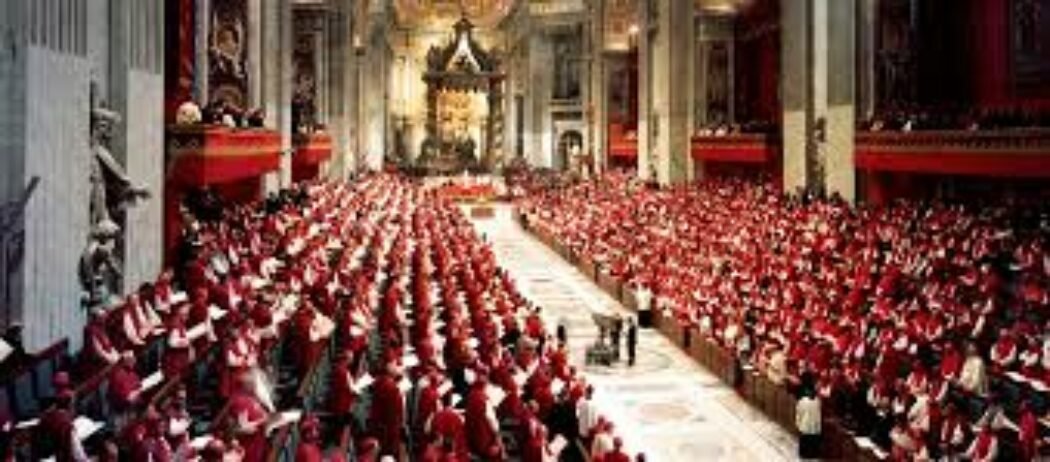
The Novus Ordo Missæ of Paul VI, with its Missal and introductory instruction, was published in 1969. The new Mass of Paul VI sparked a controversy that was not new, for since 1964, following the appearance of the conciliar constitution Sacrosanctum Concilium, all manner of liturgical experiments had been carried out, endorsed by the Roman hierarchy.
Since January 1964, the liturgy had been thrown into disarray by the combined effect of a deluge of reforming decrees and local initiatives in parishes. In almost every sphere of the Church’s life, and particularly in the liturgy, the accuracy of the provocative yet pertinent formula of Fr. Congar, who had announced «the October Revolution in the Church», was borne out. The careless suppression of the term «consubstantial» in the French translation of the Creed came, in a way, to crown and confirm the devastation of the Catholic catechism, openly set in motion from 1967. The effort to rescue the catechism had stirred a refractory state of mind among Catholics denigrated as «integrists» or «traditionalists»—a small minority, considered pariahs in matters of morals and sociologically marginalised, yet fully conscious of standing on what had always been believed, said, and done in the Church.
The prevailing opinion among the clergy and the powerful secular media leaned towards general change in the name of the Council and its «renewal». The refractory were universally labelled as nostalgia-hungry relics of a bygone age.
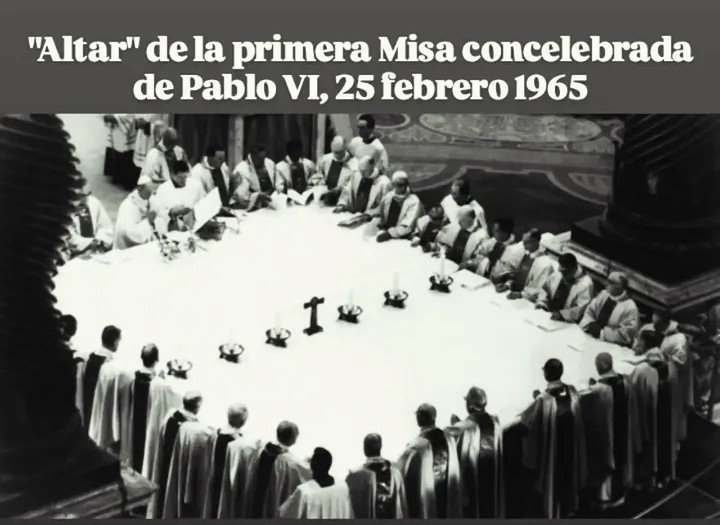
The multitude of «typical editions» of the new Missal only increased the confusion. Almost all parishes and the majority of the faithful welcomed or accepted, without great protest, the liturgical novelties tolerated or even imposed by the diocesan bishop. This is how Catholics are recognised: except in rare cases and moments of unrest, they accept without reservations the teaching of their parish priest, provided he has the agreement of the bishop, who is himself in communion with the Pope. The vast majority of practising Catholics attended Mass without owning a Missal and saw no issue with the innovations. Soon it would be said that ordinary faithful were unconcerned by the debate between the old and new Mass because they could not reliably distinguish one from the other, for the simple reason that there are more differences between two new Masses than between a Traditional Mass and a new Mass celebrated as it should be according to Paul VI’s Ordo. It is true that it is rare for Paul VI’s Ordo to be followed exactly: from the beginning, an anarchic liturgical creativity has been exercised in all directions. But, in reality, everyone can recognise the new Mass: it is in the vernacular, and the celebrant no longer faces God, to avoid «turning his back on the people». It is highly visible and more democratic. The prevailing opinion, fed or fostered by the ecclesiastical hierarchy and secular media, was that this was an improvement, the fruit of an irresistible drive towards progress and modernity.
Reinforced by broad media consensus in favour of this «new spirit» and this «rejuvenation», and perhaps without realising that unbelievers, the lukewarm, the worldly, and even the Church’s enemies occupied an important place in this consensus and were the most active in organise it, the ecclesiastical hierarchy paid little heed to protests and indiscipline. Doubtless, they were a nuisance. But the hierarchy took comfort in the belief that things would calm down spontaneously; imagining that the younger generations, enthused by the conciliar dynamic, would massively convert and join the ranks of the new Church.
In reality, two camps formed. Despite the immense numerical disparity, all the ingredients for a head-on confrontation were in place. The claims and protests of the rebels, far from diminishing, grew stronger, while the conciliar momentum gradually petered out.
Those who resolutely rejected the new Missal did not do so from a vacuum, but rather drew on the precedent cited—falsely—by Rome: the Roman Missal of Pius V from 1570.
The minority sector that rejected the new Mass also questioned the brutal prohibition of the Traditional Mass that accompanied it and never ceased to celebrate the Traditional Mass.
During the years 1971, 1972, 1973, 1974, 1975, and until 24 May 1976, no explicit, precise, and dated mention is found of an act of the Pope that promulgates the prohibition of the Traditional Mass.
The prohibition was first implicit, as a silent yet imperative consequence of the obligatory nature with which the new Mass was invested. But was such an obligation really decreed by the apostolic constitution Missale romanum of 1969? This remains a contentious point, as translations and interpretations diverge, and the controversy is public. Various decrees, notifications, or communiqués from Roman congregations declared or presupposed the obligation, by explicit or implicit reference to the Missale romanum, and on this point, the interpretation of the Missale romanum remains uncertain.
Later, the debate was considered settled by the authority of the so-called «Notification of 14 June 1971»—a notification from the Congregation for Divine Worship published in L’Osservatore Romano which was neither dated nor signed. It only received a signature and date several weeks later. Such an anomaly made it suspect, as it diminished or nullified the authority of the strict «norms» it sought to establish.
This notification, without date or signature, began by recalling that on 20 October 1969, the Congregation «gave the norms relating to particular cases and the difficulties raised by the use of the New Roman Missal» and that «it authorised the Episcopal Conferences to extend the vacatio legis until 28 November 1971». Then, it specified that «it has established the following norms»:
1. In celebrations in Latin, «the (new) Roman Missal may already be used».
2. Episcopal Conferences must «ensure that the translation and publication into the vernacular of the new liturgical books are completed as soon as possible». They shall set the date from which the translations approved by them and confirmed by the Apostolic See «may or must enter into use, either fully or partially».
«But as of the day on which the thus defined translations must be adopted in celebrations where the vernacular is used, those who continue to use Latin must use only the renewed texts».
3. For elderly, infirm, or disabled priests who have great difficulty adapting to the new Missal, it will be possible, with the authorisation of their bishop, «to continue using the Roman Missal according to the 1962 typical edition, modified by the decrees of 1965 and 1967», but with the condition that it be sine populo, that is, without any attendees.
4. Episcopal Conferences have the right to decide on the use of the vernacular «in any part of the Mass».
For Masses celebrated sine populo, any priest may use either Latin or the vernacular.
(The rest of the notification concerned the Liturgy of the Hours and the calendar.)
All these provisions were superfluous for a country like France, from which Madiran wrote, where the bishops had already anticipated and even surpassed Rome. In publishing this Notification, the Documentation catholique of 4 July was able to triumphantly specify in a note: «In France, the new Ordo Missae has been obligatory since 1 January 1970».
Certainly, this Roman notification declared the new rite obligatory. But almost immediately, it seemed to be contradicted by an act of the Pope: in November 1971, the official authorisation granted by Paul VI to the English to occasionally celebrate the Traditional rite was announced; an authorisation that was a response to the insistent requests of the Latin Mass Society, «the association for the Tridentine rite», a member of the International Federation Una Voce presided over by Éric de Saventhem. Such a privilege clearly demonstrated that the Traditional Mass had not been abolished and suggested that the prohibition was not absolute.
Faced with such uncertainty, in 1973, for the first time, from Switzerland, an official vocabulary emerged that spoke explicitly of prohibition and even derogation. In April, Msgr. Adam, Bishop of Sion, proclaimed that it was PROHIBITED to celebrate according to the rite of St. Pius V, which was ABOLISHED by the constitution Missale romanum of 3 April 1969. He specified that «the present declaration is made on the basis of authentic information and formal indication from the Authority». And in July, a communiqué from the Plenary Assembly of Swiss Bishops was published: «By virtue of Rome’s decisions, it is no longer permitted to celebrate Mass according to the rite of St. Pius V». Thus, the Swiss episcopate would have taken four years to obtain from the «Authority» (anonymous) «authentic information» and a «formal indication» about the radical reality of the derogation stemming from the Missale romanum.
In October 1973, France followed the Swiss example, in an even more indirect and impersonal manner. In the name of Msgr. Badré, Bishop of Bayeux and Lisieux, the Dean of Orbec published a communiqué stating that «concern for obedience to the Church prohibits celebrating Mass according to the rite of St. Pius V under any circumstances». And this declaration was reproduced in most dioceses. The following year, the French episcopate published, for the first time since 1969, a new ordinance on the Mass and a communiqué explaining this ordinance. To dismiss the Traditional Mass, the communiqué this time invoked «the norms dictated by the Roman Authority», adding «the will of the bishops of France». Like the Swiss episcopate, the French version spoke of an anonymous «Authority», of «Roman decisions», and of «concern for obedience to the Church», without any of the precise explanations and references that would be necessary.
Thus, in both countries uncertainty lingers about the possibility of invoking the Pope’s personal authority. It was also noted that, in general, there remained a certain reluctance to openly speak of «prohibition». The word was avoided. Periphrasis was used. The formula that gradually imposed itself consisted in simply stating, as an administrative fact, that Paul VI’s Missal «replaces» that of St. Pius V.
Sed contra, the most determined opponents, priests and laypeople alike, continued to firmly resist the liturgical revolution with their reasoned conviction that the Traditional Mass requires no authorisation.
On 28 (or 29) October 1974, a notification from the Congregation for Divine Worship «on Paul VI’s Missal» stated that «when an episcopal conference has decided that, in its territory, the Roman Missal must be adopted in the vernacular language, from that moment onwards, Mass may no longer be celebrated in Latin or in the vernacular except according to the rite of the Roman Missal promulgated by the authority of Paul VI on 3 April 1969».
As for elderly or infirm priests, the Notification forbids the bishop from authorising them to celebrate the Traditional Mass with the assistance of the faithful.
On 14 November 1974, the French episcopate published a «communiqué» accompanying and explaining an «ordinance». Since its ordinance of November 1969—i.e., for five years—the episcopate had maintained silence on the matter of the Mass. But this episcopal communiqué lashed out at Catholics who do not consider the Traditional Mass prohibited: «For some years now, the opinion has spread that the liturgical reform required by the Second Vatican Council is not obligatory. It is said, in particular, that the use of Pius V’s old Ordo Missae may continue to coexist with that of Paul VI. The norms promulgated in this regard by the Roman Authority are clear, and the will of the bishops of France is that they be respected: the Missal promulgated by Pope Paul VI must replace that of St. Pius V. Exceptions to this rule may be made only for elderly or infirm priests, in private celebrations without the assistance of the faithful and with the express authorisation of the bishop».
But if this communiqué imposed Paul VI’s Mass as obligatory, it only sought to impose it on those who remained faithful to the Traditional Mass. For in 1974, the authentic Mass of Paul VI was rarely celebrated in France: the «liturgical reform», in the name of its ceaseless «creativity», proclaimed that one cannot afford to be confined within the fixity of a rite established once and for all in 1969 and since then outstripped by the perpetual motion of the vital impulse. Yet no episcopal communiqué imposed any obligation on the practitioners of the permanent liturgical revolution. None called to order the Catholic sense of those who professed that their Mass was no longer a sacrifice and that «it is simply a matter of making a memorial»; nor those who practised buffet Masses, disco Masses, or music-hall Masses. For all of them, there was no obligation to adhere to Paul VI’s Mass. This obligation was imposed only on the faithful of the Traditional Mass.
Thus, in practice, the true statement of this «obligation» imposed by the episcopate was that Mass was to be celebrated in any way, provided it was not according to the Missal of St. Pius V. This led the «refractory» to affirm that Paul VI’s Mass was above all a «weapon by destination» against the Tridentine Mass.
The Ordinance of the same 14 November 1974 decreed that «in accordance with the decisions of the Second Vatican Council, the Roman Missal was reformed and promulgated by Pope Paul VI: ‘Missale romanum ex decreto sacrosancti oecumenici concilii Vaticani II instauratum auctoritate Pauli PP. VI promulgatum’ (Vatican 1970). The conditions for its coming into force in different countries, and the role of the episcopal conferences to this effect, were finally specified by the ‘notification’ of the Congregation for Divine Worship of 14 June 1971 (…) In France, the episcopal conference, by its ordinance of 12 November 1969, set the date for the coming into force of the French translation of the new Ordo Missae (…) The episcopal conference, in application of the ‘notification’ of 14 June 1971, confirmed its earlier decision (of 12 November 1969) and decided as follows:
1. As of the first Sunday of Advent 1974, in celebrations in French, etc., etc.
2. In the event that a celebration in Latin is foreseen, only the Missal promulgated by Pope Paul VI shall be used».
This prompted the following observations:
1. The 1974 ordinance was not merely a confirmation of the 1969 one, but also a correction: it no longer required Mass to be obligatorily in French.
2. In 1969, the French episcopate had claimed to abolish the Traditional Mass and Latin by its own authority. This time, it declared that it was acting «in application» of Roman decisions. This was implicitly to recognise that an episcopate can only substantially modify the Church’s official liturgy when applying the laws, decrees, or dispensations of the Holy See.
3. As the Roman foundation for the new liturgy, the episcopate chose the weakest one: a simple «notification» from the Congregation for Divine Worship. A foundation undoubtedly insufficient for something as transcendental as the abolition of the Traditional Catholic Mass. If such an abolition were possible, at least an explicit act of the Supreme Pontiff himself would be required.
4. In this case, the only act of Paul VI was the apostolic constitution Missale romanum of 3 April 1969, which promulgated a reformed Missal. If the reformed Missal were imposed to the exclusion of any other, it was from this constitution, and this constitution alone, that a juridically binding authority could be derived. It was not a simple decree of application published by a Roman congregation that could confer upon the new Missal an authority not granted to it by the apostolic constitution that promulgated it.
5. The episcopal order, in referring to the promulgation of the new Missal, cites the date of 1970: the date of publication, by the Vatican printing press, of a new «editio typica» of the reformed Missal, and not of its promulgation.
For centuries, theologians have debated whether texts written and published under the Pope’s authority are necessarily and always exempt not only from ambiguity but also from heresy. The Third Council of Constantinople, Pope St. Leo II, and, two centuries later, Pope Adrian II, all condemned texts «written and published under the authority» of Pope Honorius I. But it seems that no one, before the French bishops Coffy and Marty, had ever imagined imposing as obligatory the belief that a text written and published under the Pope’s authority cannot contain the slightest ambiguity.
In autumn 1975, a letter from Cardinal Villot, Secretary of State, opened the way to a new situation. This official letter was sent on 11 October to the president of the French episcopal commission for the liturgy. Its novelty lay in affirming that, by the apostolic constitution Missale romanum of 1969, the Pope «prescribed that the new Missal replace the old one, without prejudice to the constitutions and ordinances of his predecessors». For the first time, a Roman authority—and the highest after the Pope—explicitly stated this interpretation: Paul VI, by his apostolic constitution, had promulgated the disappearance of the Traditional Mass. Until then, this interpretation had only been defended as an indication.
But this interpretation would be modified in turn, less than a year later, by Paul VI himself: in his address to the consistory on 24 May 1976, the Pope no longer mentioned the Missale Romanum in referring to the Novus Ordo. He spoke of a promulgation as an accomplished fact, without specifying a date or designation: the promulgation of a new Mass that would replace the old one. It was rather a statement of intent than a reference to a decision. From that moment on, it became the Roman custom to refer to the promulgation «of 1970» rather than that of 1969: in 1970, another official edition (editio typica) of the Novus Ordo was surreptitiously printed at the Vatican. The presentation of this new Mass had already seen three successive official editions: a first «typica» edition in 1969, a second in 1970, a «typica altera» in 1975 (and a fourth in 2002). Paul VI, in his 1976 address, when seeking to cite a prior Roman document, only found the instruction of the aforementioned instruction published without date or signature on 16 June 1971 in L’Osservatore Romano.
In that same address of 24 May 1976, Paul VI ordered the disappearance of the Traditional Mass: «In the name of living Tradition, we ask all our sons and all Catholic communities to celebrate with dignity and fervour the rites of the renewed liturgy. The adoption of the new Ordo Missae is certainly not left to the free decision of priests or the faithful. The instruction of 14 June 1971 provided that the celebration of Mass according to the old rite would be permitted, with the authorisation of the Ordinary, only to elderly or infirm priests who offer the divine sacrifice without the assistance of the faithful. The new Ordo was promulgated to replace the old one, after mature reflection and in order to implement the decisions of the Second Vatican Council. It is no different from how our holy predecessor Pius V made the revised Missal obligatory under his authority after the Council of Trent.
«With the same supreme authority that comes to Us from Christ Jesus, we order the same prompt submission to all the other liturgical, disciplinary, and pastoral reforms that have matured in recent years in application of the conciliar decrees.»
This was the first time, seven years after the constitution Missale romanum, that Paul VI personally and explicitly spoke of «replacing» the old Mass with a new one, i.e., of making the latter disappear. For this, the only prior Roman document to which he referred was the suspect «instruction» published without date or signature in L’Osservatore Romano of 16 June 1971.
But this painstaking papal declaration of intent to replace the old Mass with a new one had changed level: it received explicit and formidable confirmation by being declared by Paul VI «in the name of Tradition» and «with the supreme authority that comes to Us from Christ Jesus». The prohibition of the Traditional Mass, which had been developing more or less openly for seven years, now reached its peak. At last, it became, for the first and only time, the subject of a personal act by the Supreme Pontiff: the consistorial address of 24 May 1976.
It must have been like a thunderclap. It seemed to have created a radically new situation. In theory, there were reasons why the resolve of the rebels, the «traditionalists», might be shaken, for they hold great doctrinal and supernatural respect for the Pope’s authority. Does not the invocation of his «supreme authority that comes to him from Christ Jesus» engage his infallibility, which is precisely the supreme degree of his authority? Yet Paul VI’s moral authority had been seriously and lastingly undermined since the incredible episode of «article 7».
What was article 7? Since its promulgation in 1969, the Novus Ordo was accompanied by a compendium of general norms titled Institutio generalis. Its article 7 gave an unacceptable definition of the Catholic Mass: «The Lord’s Supper, also called Mass, is the sacred synaxis or assembly of the people of God gathered under the presidency of the priest to celebrate the memorial of the Lord. Thus, the promise of Christ is especially valid for the local Church’s assembly: ‘Where two or three are gathered in my name, there am I in the midst of them’ (Mt 18:20).»
Such a definition reduced the Mass to a mere prayer meeting and a gathering of remembrance. This was immediately understood by the French episcopate: from the first edition, drafted in 1969, of their new Sunday Missal, they inserted a «reminder of faith» in which it was specified that the Mass simply consists in making a memorial of the one sacrifice already accomplished. This doctrine was maintained and reiterated by the French episcopate for several years. In Rome, however, beginning in 1970, a discreet correction to article 7 was made. This discreet correction, however, did not erase the fact that Paul VI had signed and promulgated the first version: therefore, it expressed the Pope’s thought, or at least did not contradict it.
This was a phenomenal accident, which remained unexplained. Added to this, in the consistorial address of 24 May 1976, was a manifest historical falsehood. Paul VI claimed to have proceeded with the Mass in the same manner (haud dissimili ratione) as had St. Pius V. Yet St. Pius V had not replaced one Mass with another, had not abolished the existing Mass, but rather, on the contrary, had confirmed, in matter of rite, all legitimate customs that had existed for more than two hundred years.
For six or seven years, by 1976, the refractory had widely disseminated all that needed to be known about St. Pius V’s bull Quo primum tempore. They were not so disarmed on this subject as to be fooled.
It was only at the end of the 1980s that cardinals began to make declarations, first private then public, asserting that the Tridentine Mass «has never been prohibited».
In August 1976, the French writer Michel de Saint Pierre wrote a letter to the Pope, signed together with Louis Salleron, Gustave Thibon, Henri Sauguer, Colonel Rémy, Michel Droit, and Michel Ciry, in which they stated that «Cardinal Marty himself recently revealed to us that between 1962 and 1975, Sunday practice had declined by 54% in Parisian parishes. Why? Because the faithful no longer recognise their religion in certain liturgies and a certain new pastoral approach (…) Was it not you yourself, Most Holy Father, who spoke of the self-destruction of the Church? The fact is that in France this self-destruction is at its peak, and we are witnesses to it (…) Currently, there are as many rites, practices, and opinions as there are churches, priests, communities, groups, and splinter groups (…). Everywhere, strange Masses, sometimes ecumenical, which have nothing to do with Paul VI’s Mass, are celebrated with total impunity. Is any ‘Eucharistic celebration’ permitted except the Traditional Mass?».