The Letter She Carried to Mass
A parish bookkeeper named Maria kept the layoff notice in her missal for almost twelve years.
She had received it on a Friday afternoon. The parish was merging offices, her bookkeeping position was gone, and the final paycheck would arrive in two weeks. Her husband had died the previous winter. There was a mortgage, an old furnace, and a boy beginning his first semester at community college. She knew the household balance down to the dollar: $1,146.38.
On Sunday she brought the notice to Mass. During the Gospel, she unfolded it on her lap and heard, “Your Father knows that you need all these things.” That sentence irritated her at first. God knew. Fine. The electric company also knew, and it had supplied a due date.
Still, she returned the paper to the missal at the Communion antiphon: “Seek first the Kingdom of God.” It stayed there through temporary jobs, late-night office cleaning, a furnace repair paid in three installments, and grocery bags quietly left by a neighbor who claimed she had bought too much. Providence arrived without theatrics. Much of it came in other people’s handwriting.
Years later, Maria’s daughter found the notice. On the back was a list written in blue ballpoint:
7:00 Mass. Call Mr. D. Electric due the 14th. Ask Joan about night work. Make soup.
That little list is the Gospel at kitchen-table scale. The Kingdom came first at seven o’clock. Then came phone calls, bills, work, and supper.

“Look Upon the Face of Thy Christ”
The Western Church once called this the Sunday of the Two Masters. Yet the Mass begins before either master is named. She enters the sanctuary crying, “Behold, O God, our Protector, and look upon the face of Thy Christ.”
Dom Prosper Guéranger lingers over that phrase. The Church approaches the Father as the Bride of Christ, asking Him to behold the face of the Bridegroom whose life and merits are hers. Her confidence rests there. She carries no independent guarantee, no private supply of immortality, no bureaucratic machine capable of saving itself. She is loved in the Beloved.
Then comes the Collect, almost alarming in its candor: “Protect Thy Church by Thy abiding mercy … since all mortals fall without Thee.”
That sentence belongs in every chancery, rectory, newsroom, monastery, and Roman office. Human mortality slips without grace. A pectoral cross does not remove concupiscence. Election to high office does not confer prudence in every decision. The indefectibility of the Church is Christ’s promise to His Bride; it is no canonization of each policy adopted by her servants.
The prayer also reveals what divine protection looks like. God keeps the Church by drawing her away from harmful things and directing her toward salvation. At times His mercy comforts. At times it exposes rot, frustrates a scheme, scatters an institution, or raises sons who refuse to call poison medicine. Protection can feel severe while it is happening.
Catholics living through the present Passion of the Church should take courage from the grammar of the Collect. Holy Church herself asks to be kept. She can be struck, humiliated, obscured, and left looking powerless before the world. Her need never embarrasses her. It sends her to the only Protector she has ever had.
“Better is one day in Thy courts than a thousand elsewhere.” Better one Low Mass in a borrowed room, with folding chairs and a leaking ceiling, than a thousand hours in the bright courts of a world that has forgotten its Creator. Better one absolution spoken in a cramped confessional. Better one Host received in the state of grace. The soul eventually learns the arithmetic of eternity.
The Civil War Under the Skin
St. Paul refuses soft language. Flesh and spirit lust against one another. The Christian carries a battlefield inside his ribs.
“Flesh” here reaches far beyond sexual appetite. In his commentary on Galatians, St. Thomas Aquinas follows St. Augustine: a man lives according to the flesh whenever he lives according to himself. That is why St. Paul’s list includes enmities, jealousy, wrath, quarrels, factions, and sects. Disordered self-love can wear respectable clothes. It can quote canon law, defend a sound proposition, and savor every cruel word typed about an enemy.
This deserves a hard examination among traditional Catholics. A man may hold the right missal and nurse hatred. He may diagnose Modernism accurately while feeding on anger until his children experience the crisis in the Church mainly as the permanent foul weather inside their father. A woman may recognize a scandal before her friends do and then enjoy the small throne that superior knowledge gives her. The cause is holy. The flesh still wants a cut.
Truth sometimes requires a blow struck cleanly. St. Paul himself warns that those who practice grave sins “shall not obtain the kingdom of God.” Mildness has never meant smearing the border between truth and error. Yet the Apostle places faith, modesty, continency, and chastity beside charity, joy, peace, and patience. The Holy Ghost produces the whole crop. Zeal that steadily destroys peace, prayer, family affection, and honesty has picked up something foreign along the road.
Guéranger makes a distinction our easy age would rather forget: penance answers a debt of justice; mortification is demanded by prudence. St. Thomas goes to the root. A good physician treats the cause of disease, so the flesh must be tamed rather than given endless opportunities and then blamed after the fall.
For most laymen, the needed cross will look ordinary. Leave the phone in another room when ecclesiastical gossip starts scratching at the mind. Refuse a second drink. Keep Friday with enough seriousness to feel it. Rise when the alarm sounds. Swallow the devastating reply that would win an argument and wound a spouse. Fast with discretion. Turn the eyes away quickly. None of this earns grace. It clears the weeds around a life already planted by grace.
St. Paul says those who belong to Christ have “crucified their flesh.” Crucifixion takes time. The old appetites remain alive enough to complain, yet they lose the right to govern. One nail goes through vanity, another through lust, another through the furious need to have the last word. Christ shares His Cross because He means to share His freedom.
What Fruit Feels Like
The Latin text gives “works” of the flesh and “fruit” of the Spirit. St. Thomas explains the difference beautifully. Sin is an alien growth, something twisted away from the nature God planted in us. The acts born of grace deserve the name fruit because they grow from a living source and carry a foretaste of sweetness.
That sweetness may be quiet. Patience looks like a mother answering the same frightened question after a child wakes at two in the morning. Longanimity is the Catholic who has prayed twenty years for a son and still puts his name beneath a candle. Continency may consist of one unseen decision made at a laptop. Peace can exist while the medical report remains unchanged.
Fruit also exposes counterfeit spirituality. If years spent studying the Church crisis make us less capable of charity, joy, gentleness, and chastity, our reading has outpaced our praying. More information will deepen the rut. The remedy may begin with confession, sleep, a walk with one’s wife, and a week away from the glowing screen.
One father discovered this when his eight-year-old looked up from dinner and asked, “Did the Church do something bad again today?” The boy had learned to recognize the expression on his father’s face whenever Rome appeared on the phone. From then on, the device went into a kitchen drawer before grace. The father kept reading. He also quit forcing five children to eat supper inside the chancery.
The Church needs watchmen. She also needs homes where children associate Catholic life with candles, chant, forgiveness, jokes at the table, and parents who possess souls larger than the latest outrage. The fruit of the Spirit is evidence that Heaven has already begun its work in fallen ground.
The Master Hidden Inside Anxiety
Mammon means riches, though the old commentators give it a wider reach: possessions, worldly interest, the visible means by which a man tries to make himself secure. Cornelius à Lapide points out that Our Lord condemns the service of riches rather than their mere possession. Abraham had wealth. So did David. A man owns money when he orders it toward duty, almsgiving, worship, and the good of those entrusted to him. Money owns the man once its commands outrank God’s.
Father Leonard Goffine defines service of God in homely terms: faithfully doing what God asks according to one’s state in life, for love of Him. That definition brings the Gospel uncomfortably close. The master of a life is revealed by the voice that settles practical disputes.
Which voice wins when Sunday Mass collides with a child’s tournament? When telling the truth threatens promotion? When another pregnancy rearranges the careful plan? When a priest knows that reverence will cost him favor?
Anxiety enters because divided service is exhausting. The Greek term behind “be solicitous” suggests a mind pulled apart. Lapide describes a care that distracts the heart from God and bends it toward the earth. Christ leaves room for foresight, honest labor, savings, insurance, and tomorrow’s lunch. St. John Chrysostom, preserved in St. Thomas’s Catena Aurea, says that Our Lord forbids anxious care while leaving work in place.
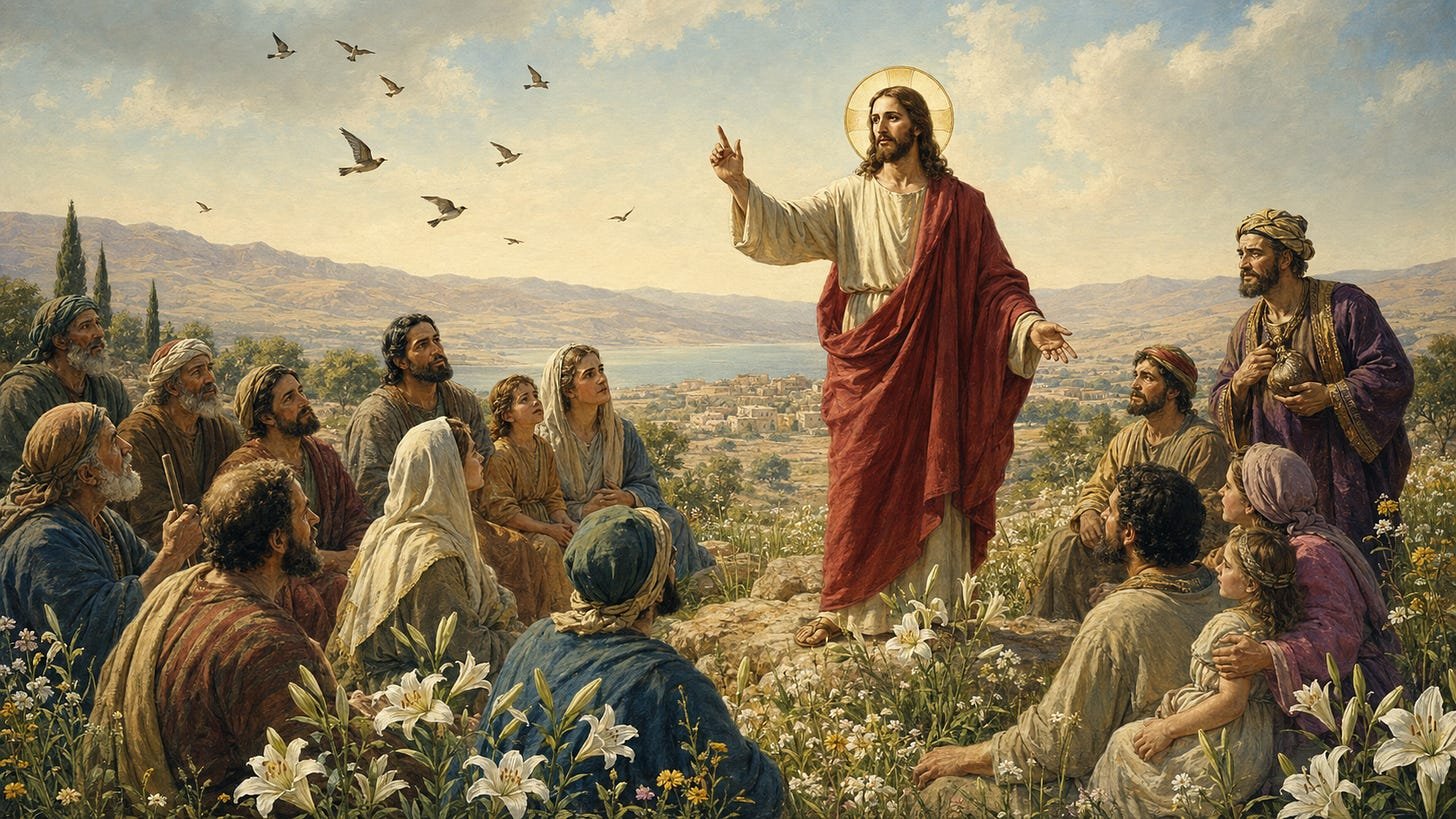
The birds still search for food. They build nests one twig at a time. Their freedom lies elsewhere: no bird mistakes the barn for Providence.
Our Lord goes straight to the wound. “Your Father knows.” He says Father rather than a distant divine title, because the cure for pagan anxiety is filial confidence. The Gentile scans the horizon as an orphan. The baptized man works beneath a Father’s gaze.
This promise carries no guarantee of a full pantry on our preferred schedule. Martyrs have starved. Saints have watched farms fail and children die. “All these things shall be given you besides” means temporal goods remain under Providence and arrive in the measure God sees conducive to salvation. Sometimes He gives bread. Sometimes He gives the strength to lack it without betrayal. Either gift comes from a Father.
When Mammon Learns Latin
Institutions suffer temptations much like men. A diocese can begin serving solvency, reputation, access, applause, or bureaucratic peace. Mammon wears a Roman collar quite comfortably. He asks only that eternal things be managed according to worldly risk.
The old Mass has made this temptation visible. Traditionis custodes declared the reformed liturgical books the “unique expression” of the Roman Rite’s law of prayer, barred the establishment of new traditional groups, and ordinarily pushed their Masses outside parish churches. A 2023 rescript reserved key dispensations to the Holy See. The ancient worship of the Roman Church was turned into a precarious administrative exception by the very men charged with guarding what they received. The text is plain.
Only days ago, Leo again defended the conciliar revision as necessary, praised the “streamlining” of the older books, and acknowledged that post-conciliar abuses still occur. His August 26 audience arrived four days before this Sunday’s Introit tells the dispossessed faithful that one day in God’s courts surpasses a thousand elsewhere.
There is a grim irony here. Catholics drawn to a rite that teaches detachment from princes have been trained to wait upon signatures, waivers, consultations, and two-year permissions. A permission can expire. The patrimony it regulates remains holy. The Mass of Ages does not acquire its worth from a favorable memo.
The answer is fidelity without frenzy. Expose the lie. Keep the receipts. Refuse euphemisms. Then pray for the man whose words you have criticized, examine your own sins, and return to the duties sitting ten feet from your desk. Catholic polemic should leave the reader clearer, steadier, and more ready to save his soul.
Better Than Trusting Princes
This summer made the Gradual painfully current: “It is better to take refuge in the Lord than to trust in man. It is better to trust in the Lord than to trust in princes.”
After the July 1 episcopal consecrations at Écône, Rome’s doctrinal office declared the act schismatic, treated the six bishops as excommunicated, extended grave penalties to the Society’s clergy and formal adherents, and pronounced its confessions and marriages invalid. The Roman decree and explanatory note use the heaviest language available. The Society answered that the four men were consecrated as auxiliaries without jurisdiction, owing to an exceptional necessity for preserving Tradition and serving souls. Its July 1 statement is equally clear about its intention.
The canonical arguments merit sober treatment. Sunday’s Gradual reaches beneath them. No prince becomes the object of theological faith. Authority comes from God, remains answerable to the purpose for which He gave it, and finds its highest law in the salvation of souls. Papal primacy does not require a Catholic to pretend that inherited worship became dangerous in 2021, or that grave confusion throughout the Church suddenly grows harmless whenever a dicastery looks elsewhere.
Rome’s thunder against Tradition, while doctrinal ambiguity and liturgical degradation wander about in daylight, reveals a hierarchy of anxieties badly disordered. Still, Écône itself remains an instrument. Christ owns Tradition. No diocese, society, personality, or news outlet can carry the weight of being savior.
Before the consecrations, the SSPX published a prayer for the future bishops. It asked for pastors filled with faith and charity who would never betray truth from praise or fear, make darkness light, or call evil good. Pray that for every bishop. Pray it for the priest at the mission chapel and the father kneeling beside his children. Then ask it for yourself. Every Christian governs some small territory where fear seeks a throne.
Taste and See
The Offertory gives the answer to the whole Mass: “The Angel of the Lord encamps around those who fear Him, and delivers them. Taste and see how good the Lord is.”
The crisis gets discussed to death. The altar does something about sin.
In the Secret, the Church calls what lies before God a saving sacrifice, a cleansing of our offenses, and a propitiation of divine majesty. Man’s deepest emergency was never food, clothing, employment, or even the visible collapse of ecclesiastical government. It was sin. The Father has answered that emergency with the Victim upon the altar.
Then, as the faithful approach the rail, the Communion antiphon repeats the Gospel: “Seek first the Kingdom of God.” The command now has flesh and blood. The Kingdom comes under the appearance of bread. The King gives Himself before He sends us back to bills, sickrooms, hostile offices, and confused parishes.
This changes anxiety from the inside. We still feel the pressure in the chest. We still run numbers, call the doctor, and wonder what will happen to the children. Yet fear has lost its altar. It may speak; it may never offer commandments.
The Postcommunion asks that the Sacrament continually purify and strengthen us and carry us to everlasting salvation. There is the final measure of Providence. God arranges all things toward an end beyond the grave. A lost job, a closed church, an illness, even an unjust condemnation can become material in the hands of grace. None receives the last word.
Before next Sunday, write down the thing whose loss frightens you most. Be concrete. Salary. Health. A child’s affection. Access to the Mass. Reputation. Then ask what obedience that fear has already demanded.
Choose one small mortification aimed at its root. Make one act of confidence that also fulfills a real duty: send the application, schedule confession, give the alms, apologize, cancel the Sunday intrusion, or ask for help. Providence rarely rewards passivity. Maria’s first line was Mass; her second was a telephone call.
And when the mind begins its old midnight trial, answer it with the words the Church has placed in our mouths: “It is better to trust in the Lord.” Say it slowly enough to hear whom you have been trusting instead.
The Father knows what His children need. He knows what His Church needs too. Our task is neither to invent a third master nor to negotiate a peace between Christ and Mammon. We seek His Kingdom and His justice, crucify whatever keeps us from them, and do the next duty with both hands.
Behold, O God, our Protector. Look upon the face of Thy Christ. Keep Thy Church when her human guardians stumble; keep our homes when fear prowls outside the door; keep our souls from the small apostasies committed for comfort. Teach us the order of Heaven: altar first, duty next, necessities entrusted to the Father. And through this long ecclesiastical night, give us eyes for the quiet proofs of His rule—the bird fed at dawn, the lily clothed without anxiety, and grace ripening in souls that have chosen one Master.