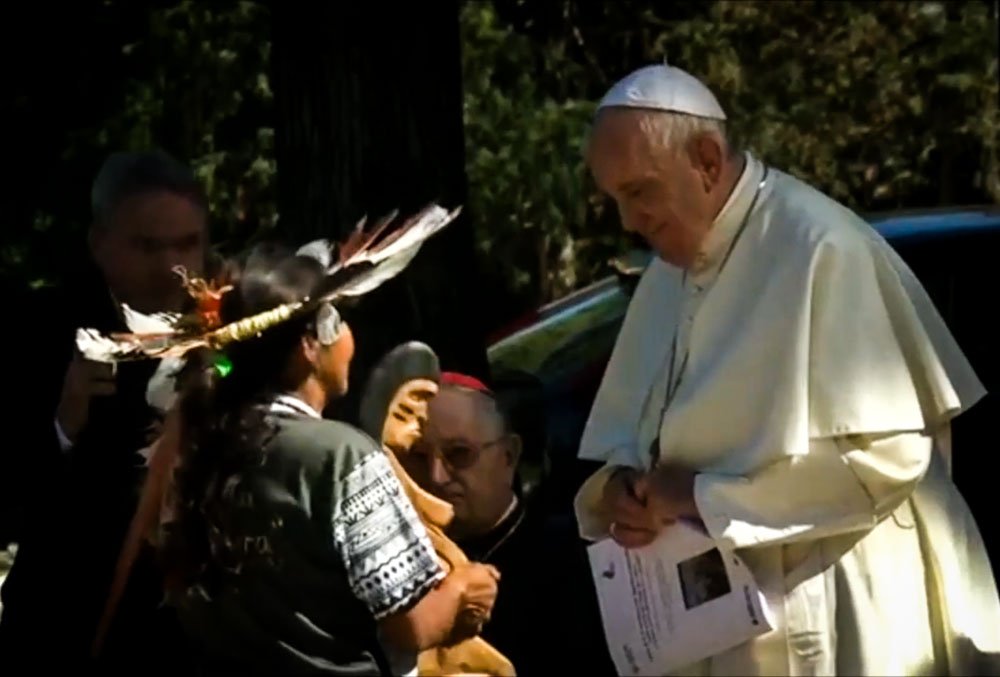
To give concrete form to his religious syncretism, on 4 October 2019 – the feast of Saint Francis – Jorge Mario Bergoglio took part in the Vatican gardens in a pagan rite attended by shamans, Franciscans and lay people, in honour of the goddess Pachamama, but the worst was yet to come. On 7 October "Pope Francis" staged a sacrilegious liturgy before the Altar of the Confession, and, singing the Veni Creator Spiritus, together with cardinals and devotees of Pachamama he set out in solemn procession parading the statue of the goddess. Pachamama is venerated in a particular way in the Andean mines of Bolivia and Peru, and besides the human sacrifices performed in her honour by the gold prospectors of La Rinconada (Peruvian Andes), articles and videos from El Deber, La Prensa and Telemundo, have reported on the human sacrifices carried out in honour of the goddess and of the horned god called El Tio.
Francis wished to send a powerful signal to believers, and he introduced into Saint Peter's an idol that demanded innocent blood. With this solemn pagan liturgy the Antipope intended to deconsecrate the Temple of Christendom in order to reconsecrate it to the Devil (with a capital D, as in Rev 12:9; 20:2). To use an expression from Leviticus (17:7), Bergoglio and the cardinals were prostituting themselves to the goat demons (false sacrifices). Francis's aim was to insult God and the Cross, thus bringing about a disastrous turning point in the history of the Church, whose destructive scope will be understood only in the near future.
Thanks to Father Charles Murr, in the month of March a photograph caused a stir showing Father Robert Francis Prevost kneeling while taking part, in 1995, in a rite in honour of Mother Earth. Newspapers in the service of the synodal church rebelled against this frontal attack on Leo XIV, and the former bishop Reinhold Nann, appointed by Francis in 2017 and married in 2025, wrote in Religión Digital: «We see an interreligious act in which a representative of Andean culture makes a payment to the earth, an offering and a dialogue with it […] Francis, in his "Canticle of the Creatures", makes clear that creatures are not gods, and yet he addresses them calling them "brothers" and "mother" in the case of the earth […] To respect the earth as a "being with a soul" nonetheless means recognising it as a creature of God. Pachamama is the earth, or rather, the soul of the earth […] We can kneel before her as we do before the Saints, provided we consider her a creature and not a Goddess». Utterly devoted to Bergoglio, Nann recalled the merits of Laudato si'.
In that same month of March, and again in the name of Laudato si', to celebrate "Mother Earth Day" a group of Jesuits published in Spain a prayer to Pachamama which reads:
«Mother Earth, teach us to love one another as brothers and to care for you with love. Guide us to give light, to be radiant like the Sun. Pachamama, Pachamama, we come to thank you for all the riches you give us. Receive this offering so that the earth may be good. Thank you Pachamama, good mother».
Since August is the month particularly dedicated to Pachamama, in Peru rites in her honour followed one upon another; in Andean tradition this is the month in which Pachamama is «fed» with offerings and «payments to the earth». In anticipation of the visit of Leo XIV, on 13 and 14 August the Southern Macroregional Meeting Weaving Voices for Dignity: for human rights and the common good was held in Cusco, where by «human rights» is naturally meant LGBT rights. In the opening ceremony organised and presided over by Mgr Jordi Bertomeu, a canonist priest of the Dicastery for the Doctrine of the Faith, in the presence of bishops Lizardo Estrada Herrera, secretary general of CELAM, and Miguel Ángel Cadenas of Iquitos, coca leaves, cheese and other foods were offered to Mother Earth. A facilitator of the sacred rite explained to those present: «This month of August is very special for us, for the Andean cosmovision; it is the month of Mother Earth, who loves us so much, who is so affectionate, so generous, who gives us food». This celebration was so appreciated by Leo XIV that on 29 August he appointed Herrera Coadjutor Archbishop of Cusco.
With the approval of the synodal church, quite apart from liturgies inspired by Harry Potter and others enlivened by clowns, «hybrid masses» are by now peacefully accepted, in which the eucharistic sacrifice becomes a fruitful occasion for interreligious dialogue, and I shall recall a few of them here. In 2019 Bishop Francis Serrao celebrated mass using the sacred brimming vessel (known as Poorna Kumbham) which represents one of the most important symbols of abundance, prosperity and divinity in Hindu rituals. On 15 August 2025 Leo XIV appointed Francis Serrao the new bishop of Mysore (India). In a church in Salvador de Bahia (Brazil), for the feast of Saint Roch the archbishop of Feira de Santana, Zanoni Demettino Castro, celebrated a mass marked by rites typical of macumba. In the church of Saint Joseph, in the name of "inclusive pantheism" (no god must be left out), the auxiliary bishop of Washington, Roy E. Campbell, declared that "God is Gods". The bishop emeritus of Saltillo (Mexico), Raúl Vera López, concelebrated mass with the Anglican priestess Emilie Smith. In the presence of Bishop José Valdeci Santos Mendes, in Brejo (Brazil) a Creed was recited whose protagonist is a "God/Goddess". In Leuven (Belgium) Islamic prayers in Arabic were recited during a mass presided over by the Jesuit Jacques Haers, in the presence of the archbishop of Mechelen-Brussels, Luc Terlinden. If such is the eucharistic faith of the bishops of the synodal church, let everyone try to imagine what the Bergoglian priests may get up to at the altar!
With regard to this profanation of the eucharist it is useless to adopt the plaintive attitude of the various bishops Strickland, Schneider or Mutsaerts, because it is the natural fruit of the apostasy currently under way in the Catholic Church, foretold at La Salette and at Fatima; by Catherine Emmerich, by Padre Pio and by other mystics.
On 2 September the International Theological Commission (ITC) published the document "Caring for our Common Home": A Responsible and Fraternal Response to the Triune God. The use of the expression Common Home, devoutly paraded throughout the document, is a subtitle of Laudato si', likewise omnipresent in Magnifica humanitas. In the typical Bergoglian style, prolix and deceptive, the very title of this "reflection" – as the secretary of the ITC, Piero Coda, has called it – constitutes a significant premise. What does a responsible and fraternal response to the Triune God mean? That all the inhabitants of the Common Home have signed the document as brothers, or that God is our brother? It is no accident that all the documents produced under Bergoglio's governance suffer from contradictions, for they are always the fruit of the absence of Truth.
The pivot of the whole discourse is naturally Prevost's guiding spirit, that is, "Pope Francis", who is at once mentioned in the opening lines because he highlighted the ecological crisis due to man's short-sighted relationship as a «predator» with nature, and in this regard the «enormous wealth of theological and spiritual content» contained in Laudato si' is recalled. The drafters of the document, in the pay of Leo XIV, state that their aim is precisely to explore in depth certain theological questions which could not be addressed in the «more restricted space of the Encyclical because of the ecological urgency». As a decoy the document proposes to listen to Catholic theology, Sacred Scripture, the Fathers and the Tradition of the Church, but in reality it forms part of the propaganda meant to nourish the cult of "Pope Francis". It is superfluous to note that for the ITC the gravest sin is identified with «ecological sin», because it causes the poor to suffer, besides being a «sin against creation and the Creator».
The scientific evidence for the anthropogenic origin of climate change denounced by Bergoglio is taken up again at no. 87: «Pope Francis (Laudato si', Querida Amazonia, Laudate Deum), in continuity with his predecessors, has not ceased to refer to the results of scientific studies in order to launch, on their basis, an urgent appeal for an integral ecological conversion, formulated in various ways». With regard to such scientific falsehoods it is not useless to repeat what I have already written in my book on Bergoglio. Uberto Crescenti, professor emeritus of Applied Geology at the University of Chieti-Pescara, formerly president of the Italian Geological Society (1999-2005), on 29 July 2015 sent a letter listing for Bergoglio the errors present in Laudato si', and wrote: «For over 10 years I have studied in particular the subject of the global warming of our Planet. I was greatly astonished by the statements contained in the Encyclical which refer to this topic. These statements are wholly in line with the ideology of the environmentalists — ideology, that is, not science». Just as inconclusive theories about the Big Bang and the origin of life are still championed as though they were scientific dogmas, in the same way the synodal church, obedient to supranational and globalist powers, goes along with the dogma of the anthropogenic origin of climate change. The document confuses «ecological sin», due to environmental pollution and of undisputed human origin, with climate change, which has an altogether different origin, as the great Zichichi too used to teach. With regard to the lies still being spread by pseudo-scientists about climate change, in these very days the climatologist Annalisa Bracco has said: "I think that today being honest is the most important thing" (LaVerità, 23 September). Given that in Magnifica humanitas Leo XIV writes that he has listened to the scientists, before approving the present document as well he would have done well to inform himself so as to understand which ones are the genuine ones.
It is undeniable that in the flood of words through which the document flows there are many truths of faith, as well as useful dietary advice: indeed, in order to keep the Common Home in good shape, at no. 124 asceticism and fasting are recommended, because they help to prevent pollution. Unfortunately the experts of the ITC then yield to animism and Darwinian evolutionism but, given the premises, this was inevitable.
The German ex-bishop already cited is convinced that the Earth, the Sun, the Moon and the stars have a soul, because Saint Francis calls them "mother", "brother" and "sister"; a similar thought is present in the "reflection", where at no. 120 we find written: «In the biblical perspective, creation is an agent, albeit not a personal one, which in its own way intervenes in the divine economy of salvation, communicating messages to humanity on God's behalf […] Creation, which nourishes and sustains us, groans in pain and anguish; will we listen to its cry?». In the following number a heresy is asserted which contradicts everything written in the preceding numbers about man as the image of God: «The universe is one. Life arose from elements whose existence preceded it and made it possible in the development of a dynamic and fecund universe, in constant movement. This unity holds, in a special way, for all the members of the biotic sphere, indebted to a single evolutionary process». Exactly like Darwin, the document maintains the idea that man and animals have followed a common evolution that differentiates them in degree, but not in quality.
In the name of the god Dialogue, a glance of admiration towards the other religions could not be lacking, «in the conviction that through the centuries they have developed forms of wisdom» (133); in the following numbers all their precious features are listed, because all of them have something to teach Christians. African religions are appreciated too: «A sacred energy unites human beings to the other animals, to plants, to inanimate beings and to the divine world» (139). It came close to omitting no mention of the spiritual riches contained in voodoo rites, in Candomblé, in macumba, in spiritism and in witchcraft. The devotees of interreligious dialogue will have regretted that not a word is said about satanism, seeing that it is winning ever more followers, especially among the young; it is no accident that in Spain the press gave great prominence to the black mass open to the public scheduled in Valencia for 1 April and officiated by the priestess Satanic Minerva (subsequently cancelled after protests).
To a mystic who must remain anonymous, also so as not to compromise the priests who follow her, Jesus said in August: "This hypocritical, false, lying church, of Satan, this church is not Mine, remember that well… Do not listen to those priests who talk, talk, talk… but say nothing about Me… accompanied by… meaningless words, without the gospel" (I omit what He said about the cardinals a few days ago!).
We are at a historic, decisive turning point. We are living the "Last Times", and without wasting ourselves in useless chatter, for Catholics it is indispensable to make a conscious choice: to stand with God or with the Devil.