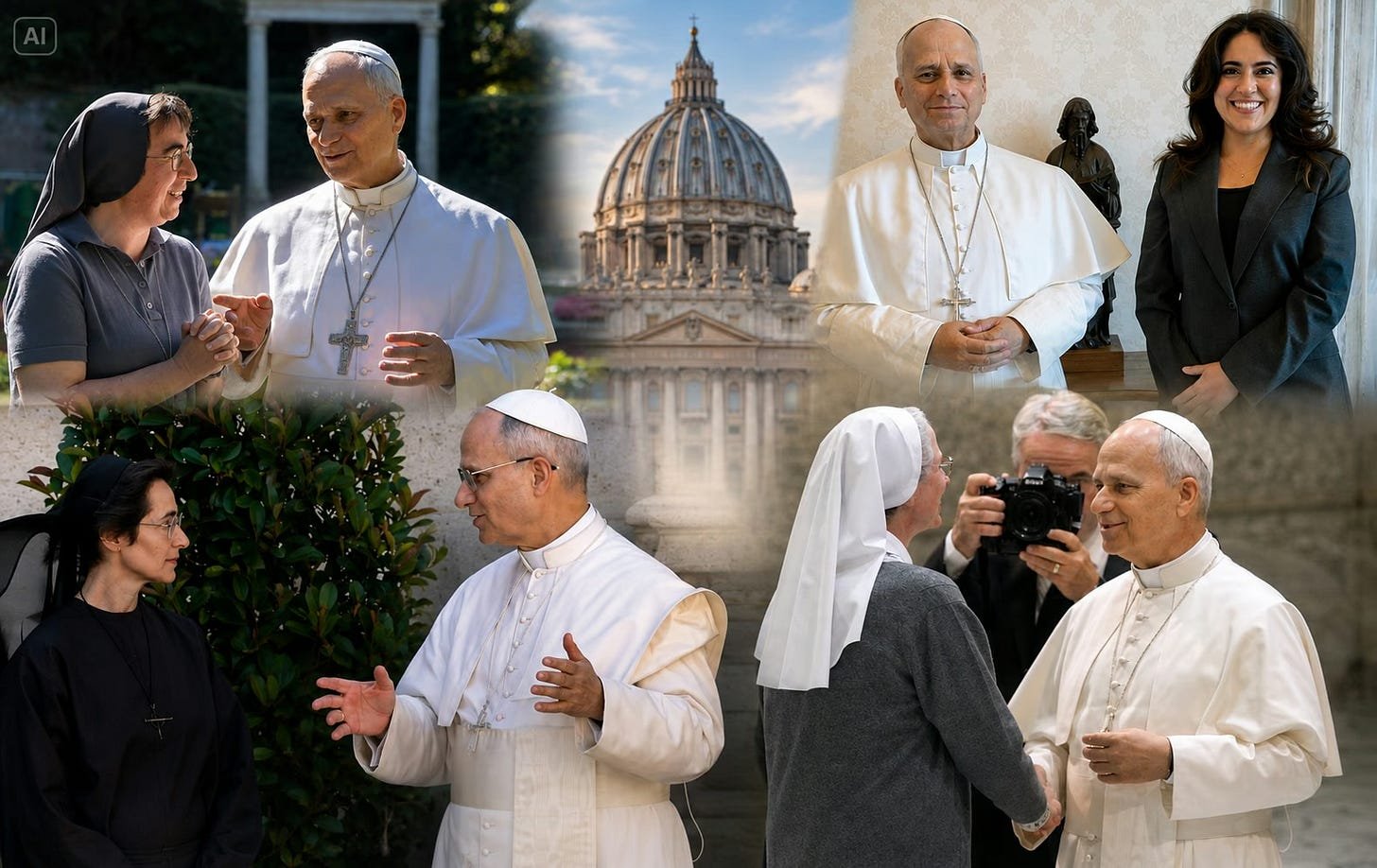
On June 2, he named María Montserrat “Montse” Alvarado, the 39-year-old president of EWTN News, prefect of the Dicastery for Communication. She will become the first non-religious woman to lead a Vatican dicastery when she takes office on November 1. Four weeks later, Leo promoted Sister Alessandra Smerilli to prefect of the Dicastery for Promoting Integral Human Development. In February, he placed Sister Simona Brambilla on the Dicastery for Bishops and retained Sister Raffaella Petrini and María Lía Zervino there. Brambilla already heads the Dicastery for Consecrated Life, where another woman, Sister Tiziana Merletti, serves as secretary.
The names keep coming. Women have been appointed to the Council for the Economy, the Holy See’s human-resources directorate, the Vatican Library, the commission for sacred archaeology, the press office, social-policy dicasteries and pontifical academies. One could mistake the cumulative effect for a hiring drive.
It is more ambitious than that.
Francis created a legal route around the male priesthood. Leo is turning it into the ordinary architecture of Roman government.
The End-Run Around Holy Orders
The Church’s hierarchy is male because Christ constituted the apostolic office that way. Intelligence, managerial skill and personal holiness settle none of it. The bishop receives a paternal and nuptial office; the priest acts sacramentally in the person of Christ the Bridegroom. John Paul II stated in Ordinatio Sacerdotalis that the Church has no authority to ordain women because this belongs to her divine constitution.
Modern feminism understands authority through the corporate categories of access, representation and advancement. If the Church is imagined as a large nonprofit, the argument follows easily: jobs at the top should be distributed without regard to sex. A bishop begins to look like a regional manager who also performs sacraments.
Francis accepted the premise years before he completed the reorganization. In paragraph 104 of Evangelii Gaudium, he affirmed the male priesthood as a sign of Christ the Spouse, then warned that the teaching becomes divisive when “sacramental power is too closely identified with power in general.” That sentence supplied the blueprint. Keep ordination male. Detach government from it.
His 2022 constitution Praedicate Evangelium declares that every curial institution exercises power received from the Roman pontiff. Therefore, it says, “any member of the faithful can preside over a Dicastery or Office,” depending upon its competence and function.
The change from the previous law is stark. John Paul II’s Pastor Bonus described dicasteries as bodies headed by a cardinal prefect or presiding archbishop. Clerics and lay faithful could participate, yet “matters requiring the exercise of power of governance” were reserved to those in Holy Orders. Even the 1983 Code still says that the ordained are qualified for the Church’s power of governance while lay faithful may “cooperate in the exercise” of it.
Cooperation has now become presidency.
Rome explains the leap through papal delegation: curial authority is vicarious, so the recipient need not possess Orders. This solution turns the papacy into an ecclesiastical power plant capable of sending jurisdiction through any wire Leo chooses. The pope’s primacy, however, exists inside the constitution Christ gave His Church. It was never a license to dissolve the relationship among Holy Orders, apostolic office and government.
Here is the strange result. The new Vatican sounds less clerical while relying upon an almost limitless ultramontanism. A pope may allegedly detach rule from Orders because every official acts in his name. The hierarchy is flattened beneath an absolute monarch.
The Pro-Prefect Gives the Game Away
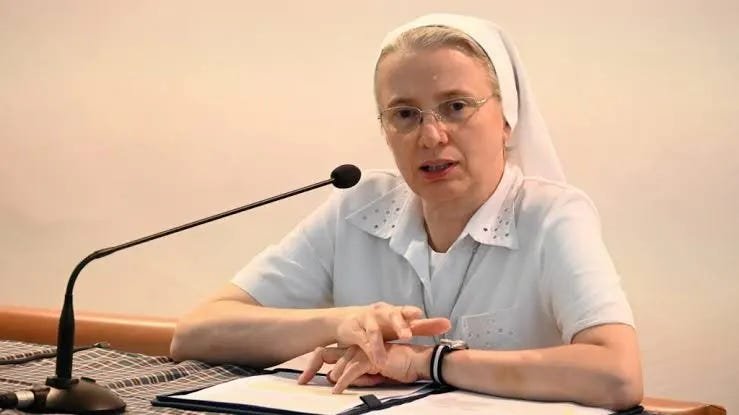
Sister Brambilla’s office does far more than coordinate convent newsletters. The Dicastery for Consecrated Life approves constitutions, regulates internal government and discipline, handles extraordinary measures, considers dismissals, and can erect, merge or suppress religious institutes. Its reach includes male communities and societies of apostolic life.
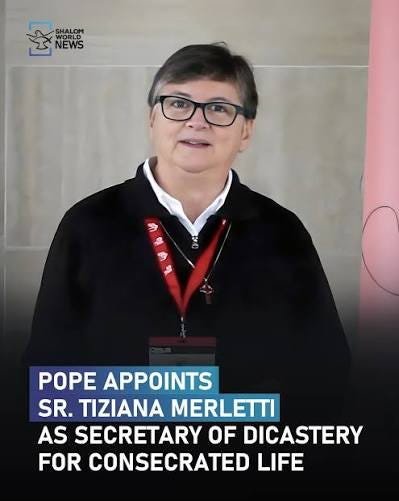
Francis made Brambilla prefect in January 2025. At the same time he created Cardinal Ángel Fernández Artime pro-prefect, without clearly explaining how their authority would be divided. Leo kept that arrangement and appointed Sister Merletti secretary in May 2025. The official hierarchy of the dicastery now places a religious sister at its head, another sister in its second-ranking administrative office, and a cardinal beside them carrying the improvised title of pro-prefect.
The pro-prefect is the tell. If Orders have no bearing on the office, why park a cardinal beside the female prefect? If they do matter, why give the unordained official the superior title? Rome answered a theological contradiction with an organizational chart.
Leo repeated the model in June when he named Sister Smerilli prefect of Integral Human Development while appointing Cardinal Fabio Baggio pro-prefect. The arrangement produces the desired headline and keeps an ordained man within reach for whatever acts may still expose the limits of the theory.
Then came the Dicastery for Bishops. This body handles episcopal appointments and establishes criteria for candidates. The final decision belongs to Leo, of course, yet its members participate in the Roman process by which future successors of the Apostles are evaluated and recommended. On February 14, Leo appointed Brambilla and retained Petrini and Zervino as members.
Women now sit inside the machinery that chooses the Church’s fathers.
Petrini’s civil position deserves a distinction. Vatican City requires competent administration, and governing a sovereign microstate is not the sacrament of Holy Orders. Even so, Leo went beyond quietly retaining her. In November 2025 he changed the law that had reserved the presidency of the Pontifical Commission to a cardinal. His new Fundamental Law of July 2026 incorporated the change. A Francis-era exception became a standing option.
Alvarado’s communications office also contains a great deal of ordinary executive work. Yet the dicastery controls Vatican News, Vatican Radio, L’Osservatore Romano, the press office, publishing and the theological and pastoral direction of the Holy See’s public voice. Vatican News itself celebrated her appointment as a continuation of Francis’s reform.
Personnel also carry content. In September 2025, Leo appointed Cristiana Perrella president of the Pontifical Academy of Fine Arts and Letters. Her curatorial portfolio included Nudes, an exhibition of sexually explicit photography by Ren Hang, along with projects devoted to erotic film posters, queer identity and club culture. Entrusting a historic pontifical academy to that artistic sensibility reveals what Leo’s Vatican considers useful expertise.
Mallorca Turns the Assumption Into a Stage
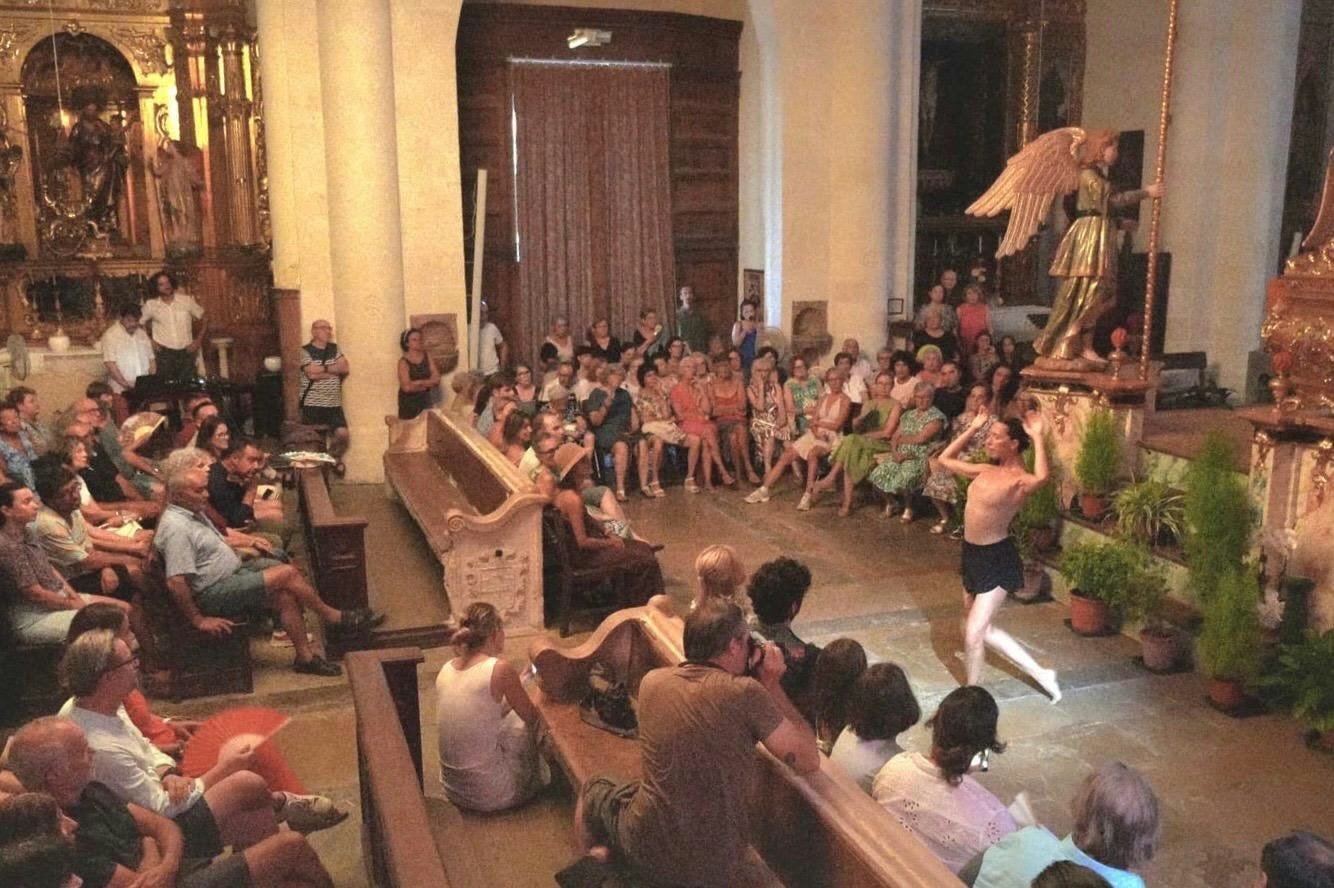
The same revolution appeared in miniature on August 15 at the Church of Sant Joan Baptista in Muro, Mallorca.
During the liturgy for the Assumption, dancer and choreographer Mar Aguiló performed a contemporary dance accompanied by organ and live sound. The work was called El Vol Màgic: “The Magic Flight.” Musician and anthropologist Txema González directed the project, with technical support for the “spatialization” of sound. The parish priest supported it.
The Diocese of Mallorca proudly announced that the work had been conceived specifically for the “liturgical context” of the Assumption. Dance, sound and organ “dialogued” with the church’s architecture and the liturgical celebration. The diocesan calendar described it even more plainly: contemporary dance and sound art inside the liturgy.
Read the diocese’s chosen nouns: “sound, body, space and ritual.” God never appears in that cluster. Neither do sacrifice, grace, heaven, sin, redemption or the Mother of God. The Mass is treated as an immersive cultural environment, a venerable shell into which artists insert a fresh experience.
The feast chosen for this experiment makes the offense sharper. Pius XII defined the Assumption with magnificent precision: the Immaculate Mother of God, ever Virgin, was assumed body and soul into heavenly glory. Mary did not achieve a “magic flight.” Almighty God exalted His Mother, Queen and spotless creature. Her body matters because it belongs to her person, was sanctified by divine maternity, and has reached the glory promised to the redeemed.
Mallorca took a dogma about God’s supernatural action and filtered it through the contemporary artist’s body.
The defense will arrive dressed as inculturation. Mallorca has old Assumption customs; the creators researched them; organ music was involved. Research cannot create a liturgical rite. The Council’s own constitution says that no one, “even if he be a priest,” may add or change the liturgy on his authority. A later Vatican directory warns that sacred liturgy “can never be reduced to a mere aesthetic reality”.
Contemporary dance may have a theater. The Holy Sacrifice has another purpose.
There is an irony here worth savoring. Catholic tradition has exalted one woman above every apostle, bishop, priest, king and artist who ever lived. Mary needed no clerical title. Her greatness came through grace, divine maternity, virginity, obedience and a humility that modern career feminism can barely comprehend. On her great feast, the parish offered the congregation a choreographer’s exploration of “body and space.”
Rome’s pink appointments and Mallorca’s dance share a governing instinct. Received form becomes raw material. The office remains while its sacramental logic is reassigned; the feast remains while its liturgy becomes a venue. Current needs supply the meaning.
Belgium Sends the Right Ambassador
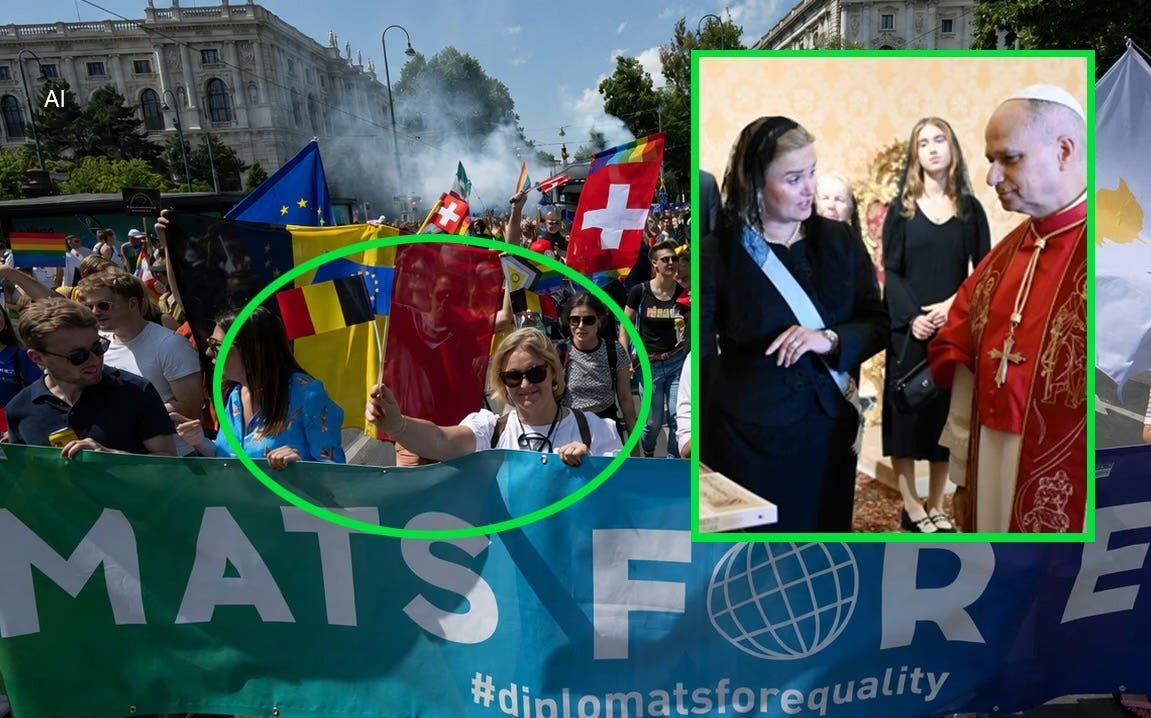
One day after the Mallorca diocese praised its experiment, Belgium’s new ambassador to the Holy See arrived with an interesting résumé.
Leo received Caroline Vermeulen’s credentials on August 27. Accepting an ambassador is an ordinary diplomatic act, and it does not amount to endorsing every cause she has supported. The Holy See has maintained relations with regimes far more hostile to Catholic teaching than Belgium.
The significance lies in how naturally Vermeulen fits the new atmosphere.
She belongs to International Gender Champions, whose profile for her praises gender diversity and pledges her support to the network’s parity program. In 2023 she personally marched in the Vienna Rainbow Parade with “Diplomats for Equality.” She appeared again with the diplomatic contingent at the 2026 Pride parade. During Pride Month in 2024, she introduced a Belgian film about a transgender teenage ballerina at an event co-hosted by Belgium’s mission.
The Vatican’s credential announcement lists her diplomatic stations and degrees. Such notices rarely catalogue political activism, so the omission proves little. Her appointment still tells us what Belgium expects to encounter in Rome. A diplomat publicly committed to the gender agenda now represents a militantly secular European state before a Vatican that speaks the same institutional dialect: inclusion, parity, diversity, listening and human dignity.
Belgium did not send a provocateur to storm a hostile court. It sent a polished emissary to a bureaucracy that already knows the vocabulary.
The Revolution Without Ordination
These stories reach the same point from different directions.
At the Curia, sacramental hierarchy is separated from executive rule. In Mallorca, inherited worship is opened to artistic intervention. At the diplomatic level, sexual difference becomes one more “diversity” category managed by professional elites. Each move preserves the Catholic noun—prefect, liturgy, dignity—while changing the world carried inside it.
This explains why the Vatican’s women strategy deserves more scrutiny than a simple debate over competence. Plenty of the appointees may be devout, intelligent and excellent at their jobs. A few appear more doctrinally conservative than the cardinals around them. Personal quality cannot settle a constitutional question.
The feminist victory comes through the redefinition of power. Ordination is left standing as a sacramental specialty while government, policy, episcopal selection and institutional voice migrate into a baptized managerial class. Female ordination becomes less urgent once women can exercise many of its public effects without receiving the sacrament.
The Church has always known formidable women: abbesses, foundresses, mystics, martyrs, scholars, queens and saints who rebuked prelates when duty demanded it. Their authority flowered within a sexed sacramental order. Saint Catherine of Siena required no seat on the Dicastery for Bishops to command the attention of a pope. Modern feminism finds such glory insufficient because it measures dignity by proximity to bureaucratic control.
For a Catholic, the pressure point is obvious. Papal imprudence occurs in history. Bad appointments prove little by themselves. Here, however, a claimant to universal jurisdiction is using legislation to revise the relationship between Orders and governance, normalizing the revision through repeated appointments, while diocesan authorities turn the liturgy into a laboratory and Roman diplomacy glides along in the language of the sexual revolution.
How much of the conciliar Church’s visible constitution can be functionally inverted before defending it becomes an exercise in supplying Catholic meaning to an institution that operates by another theology?
Leo could draw a line. He could reserve jurisdictional decisions to the ordained, clarify the anomalous pro-prefect arrangements, and distinguish lay expertise from apostolic government. The bishop of Mallorca could order reparation and tell his priests that the Mass is no artist’s studio. Rome could receive Vermeulen with diplomatic courtesy while publicly proclaiming the created reality of man and woman.
The present course runs elsewhere. Francis drew the route around the male priesthood. Leo is paving it, staffing it and writing it into law. The feminist revolution has learned to live without a chasuble, and the Vatican is giving it permanent office space.