The sequence is almost too perfect.
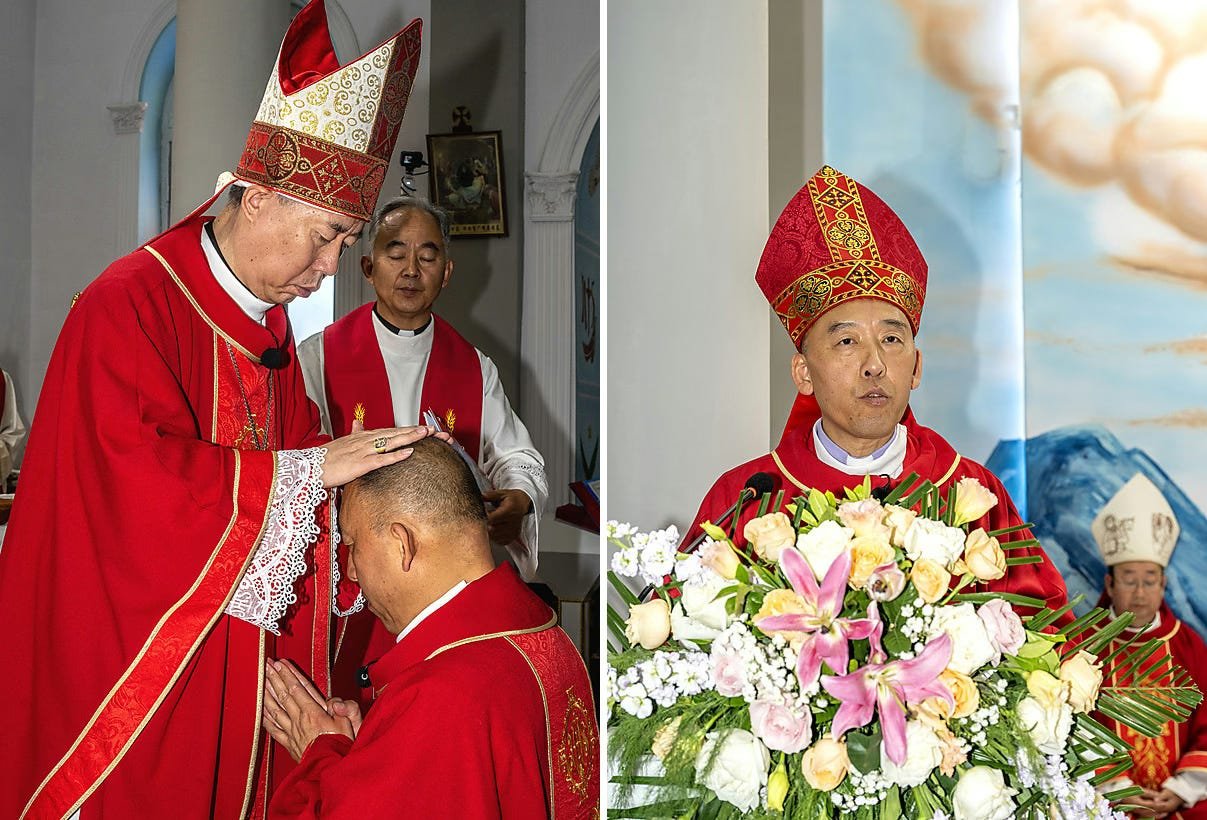
On April 28, the state-managed Catholic apparatus in China elected Father Paul Liu Honggang to be bishop of Datong. On August 10, Leo XIV appointed him. On August 31, Liu was consecrated.
Beijing chose first. Rome supplied the mandate afterward.
That is the ugliest story today because it concerns the constitution of the Church herself. A bishop is not a branch manager whose appointment can be divided amicably between two human resources departments. He is a successor of the Apostles, charged to teach the faith whole, govern the flock in Christ’s name, and resist the wolves. In Datong, the wolf helped choose the shepherd.
Beijing’s Candidate, Rome’s Apostolic Succession
The chronology comes from the two systems’ own publications. The Chinese Catholic Patriotic Association’s website says Liu was “elected” bishop-designate on April 28 and identifies him as vice-director of the Shanxi provincial Patriotic Association. The Vatican bulletin says Leo appointed him on August 10 after approving his candidacy under the secret Sino-Vatican agreement.
Even the ordination reports disclose who owns the process. The Chinese account says the secretary general of the state-recognized Council of Chinese Catholic Bishops read that body’s decree of approval. It does not mention Leo’s appointment. Rome speaks as though it appointed a bishop; Beijing reports the installation of the man its machinery had already selected.
Liu had administered Datong since 2005 and climbed within the Patriotic Association. In October 2018, he personally led priests, sisters, and faithful in a flag-raising ceremony organized under the guidance of Communist Party offices. The official report praised the event for strengthening national consciousness and promoting “socialist core values.” The photographs and account remain online.
A month later, eight Datong Catholics signed an anguished letter. They reported the destruction of a cross and a church, government obstruction of Catholic gatherings, restrictions on regular Mass, and difficulty obtaining Bibles and religious books. Their question now reads like prophecy: would the Vatican compromise with Beijing and turn faithful Catholics into “scapegoats” for diplomatic relations? AsiaNews published the letter.
Liu answered as diocesan administrator. He called the allegations entirely fictitious, denied that the signatories belonged to his diocese, and demanded the report’s removal. His signed denial is also public. In 2023, authorities demolished a historic building used by Datong priests and sisters. This week, even AsiaNews’s comparatively restrained profile connected the destruction to two decades of tightening Party restrictions.
When his people cried that the state was crushing Catholic life, the future bishop did not become their public defender, but the system’s denier. Leo has now placed the crozier in his hand.
Communist Re-Education for Clergy

(Communist Chairman Mao Zedong, pictured above, is widely estimated by historians to have been responsible for the deaths of roughly 40 to 80 million people through man-made famines, forced labor, mass executions, and political purges.)
The record grows darker. On June 25, 2021, Liu personally led Datong’s priests on a Communist Party-history education excursion. They visited the Daqüanshan memorial and the Dongfanghong Museum, studied Mao Zedong and Communist revolutionary history, and examined Mao badges, quotation books, portraits, and collected works. According to the official account, the clergy came away wishing China still greater prosperity under the Party’s leadership.
Then came the hymn in the headline. Liu wrote a poem celebrating the Communist Party’s centenary and claimed to express the sentiments of “all the clergy of the Diocese of Datong.” Call it a poem by genre; its function was hymnody. It offered corporate clerical praise to the power suppressing Catholic life in his own diocese. Crosses had been torn down. A church had been demolished. Mass was restricted, and Bibles were difficult to obtain. Liu found no public poetry for the Catholics enduring those humiliations. He found his lyrical voice for the Party responsible for them.
That poem ruins the excuse that Liu was merely enduring an unavoidable system to preserve some breathing room for the Faith. He led the lesson. He escorted his clergy through a museum of Maoist relics, absorbed the official revolutionary catechism, and then put their collective voice at the service of the regime’s centenary cult. A bishop should form priests in the mind of Christ. Liu helped form them in the mythology of Mao.
Here modernism and Communism meet. Modernism dissolves revealed religion into historical experience and endless adaptation; the Party decides which history the Church must experience and what the adaptation must serve. Once Christ’s social kingship is treated as an embarrassment from another age, priests can be reassigned as chaplains to the state’s mythology. “Sinicization” names the merger: Communist content dressed in Catholic vestments.
Leo has taken that public record and crowned it with apostolic authority. Beijing supplied the political formation; Rome supplied the mitre. The Party gained a bishop who had already sung its praises in the name of his priests. Meanwhile, Austria bars the SSPX from saying the Rosary in a Marian basilica, and Cardinal Radcliffe tells traditional Catholics that “unity” requires surrender. Communist praise is processed as diplomacy. Catholic resistance is prosecuted as schism.
The Party Chooses; Rome Sacralizes

Diplomacy with a persecuting government is not automatically betrayal. Popes have negotiated concordats with hostile rulers to preserve what room they could for the Church. The moral question is what the negotiation protects and what it teaches the persecutor he may keep doing.
The Sino-Vatican agreement remains secret. Its visible product, however, is plain. Beijing retains the machinery that vets, elects, publicizes, and politically disciplines candidates. Rome enters late, gives assent, and calls the result an appointment. The Party receives Catholic legitimacy without surrendering Party control.
This changes the public meaning of apostolic authority. The old martyrs refused to let Caesar define the terms under which Christ could be confessed. The new arrangement allows an officially atheist power to curate the episcopate, provided Rome is permitted to bless the final list.
The underground Catholic hears the message. Your fidelity may cost your church, your livelihood, or your freedom. The careerist who learns the language of “Sinicization,” raises the flag, and survives inside the Patriotic Association can eventually receive Rome’s own seal. Communion has become an incentive structure, and the incentives favor accommodation with the persecutor.
(...)
The Question Arrives Without an Invitation
No single bad appointment or cruel restriction settles the theological status of a pontificate. The harder question arises from the pattern. Catholic authority exists to guard the deposit of faith, defend divine worship, and protect the flock from the powers of this world. What happens when the claimants to that authority repeatedly reward accommodation with those powers, elevate men who blur revealed morality, and use canonical force most confidently against Catholics preserving the received religion?
That is where the Catholic instinct begins. It is not principally a dislike of personalities. It is a crisis of intelligibility. How can an institution remain the Church’s reliable rule of faith while its governing class makes apostolic succession negotiable with an atheist state?
A shepherd may act imprudently. He may sin. He may appoint a scoundrel. But when the exceptions form a governing method, Catholics are entitled to ask whether they are looking at the abuse of Catholic authority or the operation of another religion wearing its legal shell.
Leo should publish the China agreement and explain why Liu was acceptable.
Until then, spare traditional Catholics the sermon about unity. Unity severed from truth is only solidarity among administrators. Christ prayed that His disciples would be one in Him—not one in submission to Beijing.