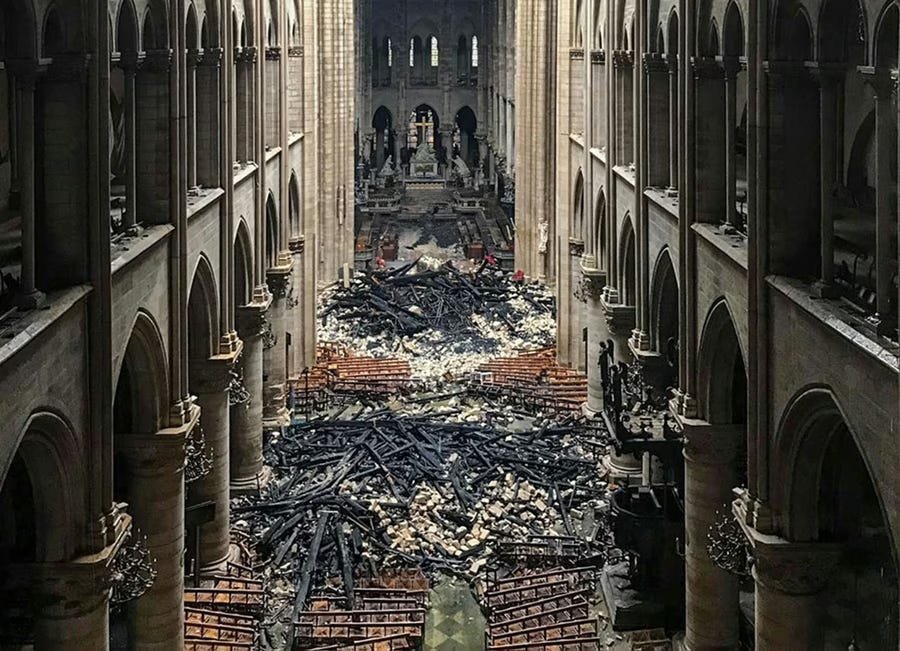
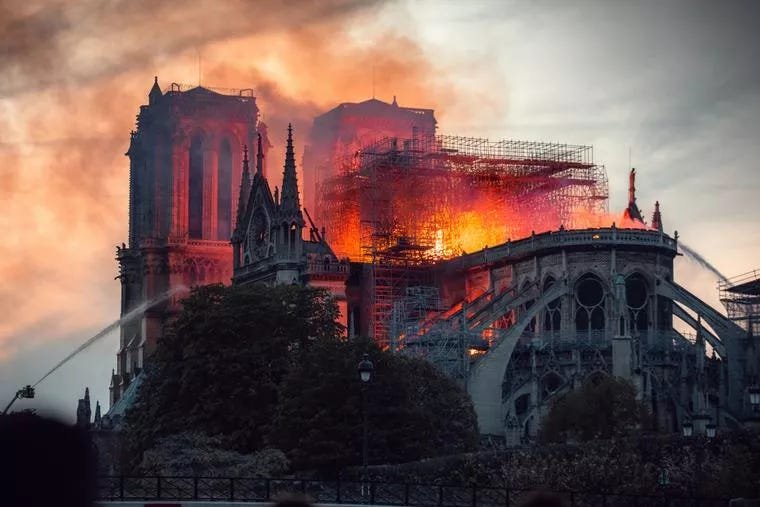
On April 15, 2019, shortly before the massive inferno erupted and nearly consumed Notre Dame Cathedral, something profoundly beautiful filled its ancient nave, seemingly from another age. The choir sang the Magnificat, the Marian hymn of praise with its sacred words rising beneath the vast Gothic vaults, while the Cathedral’s 7,800 pipe organ thundered through the ancient stones like the voice of centuries. For one fleeting moment, heaven and earth seemed to meet in song—an echo of the sacred innocence that had endured and embedded within those walls for generations.
And then, moments later, the flames came.
What followed was more than the burning of a building. It was a haunting image of a civilization watching one of its great repositories of memory, beauty, faith and innocence consumed before its eyes. For centuries, Notre Dame stood as a visible testament to the sacred, a place where generations had brought their children, their prayers, their grief, and their hope seeking solace from the holy edifice. And on that evening, just before the conflagration, the Magnificat had filled its nave with humble and glorious praise.
It is difficult not to see the symbolism.
What happens to a civilization when the sacred songs continue to echo, but the memory of what they mean evaporates?
Recovering innocence in a secular world may begin with recovering that memory.
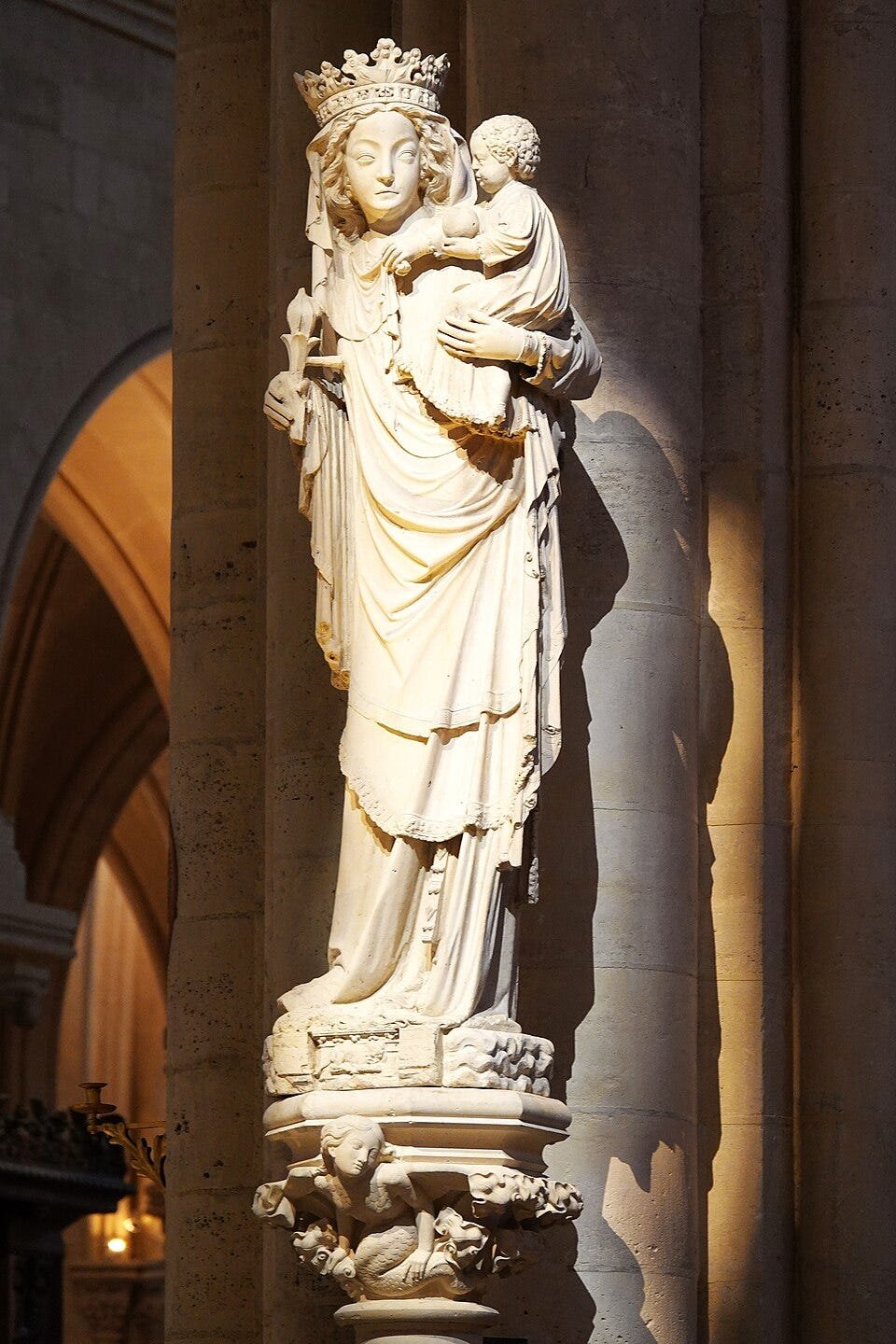
(above) The 14th century statue of Our Lady and Jesus still stands at the pillar of Notre Dame Cathedral where Paul Claudel experienced his profound conversion in 1889.
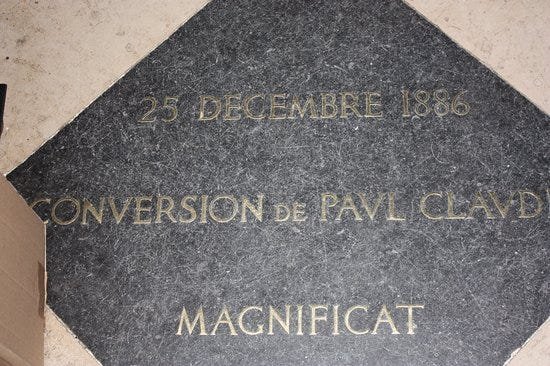
The same Notre Dame Cathedral that fire tried to consume and extinguish, once became the furnace of conversion: there, on Christmas 1886, as the children’s choir also sang the Blessed Mother’s Magnificat, grace fell upon a young French teen, Paul Claudel like falling fiery embers and rendered him a converted soul.
The Moment of Conversion
He described the moment by stating, “In an instant, my heart was touched, and I believed.”
It was cold and bitter Christmas Day 1886, the cynical and confused 18 year old French political science student, Paul Claudel stepped into High Mass at Notre Dame Cathedral of Paris, which was crowded with noisy tourists. Claudel was annoyed and distracted by the congregation. Yet, he returned later in the day for Vespers and “stood near the second pillar at the entrance of the chancel, to the right, on the side of the sacristy.” Claudel “stood near the famous 14th century statue of Our Lady and the Child Jesus.” (see above). There, he listened to the singing of the psalms and the Magnificat by the Cathedral’s children’s choir.
Claudel describes the astonishing moment during Vespers when, amid the ancient rhythms of prayer, something within him seemed to awaken—as though eternity itself has suddenly broken through the veil of the ordinary:
“Then occurred the event which dominates my entire life. In an instant, my heart was touched and I believed. I believed with such a strength of adherence, with such an uplifting of my entire being, with such powerful conviction, with such a certainty leaving no room for any kind of doubt, that since then all the books, all the arguments, all the incidents and accidents of a busy life have been unable to shake my faith; nor indeed to affect it in any way.”
“I had suddenly experienced the excruciating consciousness of the Innocence, of the eternal childhood of God, an ineffable revelation.”
Claudel continued to describe his powerful conversion experience:
“In trying, as I have often done, to remember the minutes which followed that extraordinary moment, I can identify the following steps or elements (these, however, formed but one flash of lightning, a single weapon used by Divine Providence to reach and finally open wide the heart of a poor desperate child): “How happy are those who believe!—If only it were true! And yet?—It is true! God exists. He is there. He is someone, He is a being as personal as I am! He loves me, He calls me.”
Tears and sobs had come, and the tender hymn of the Adeste only added to my emotion. Ma Conversion.”
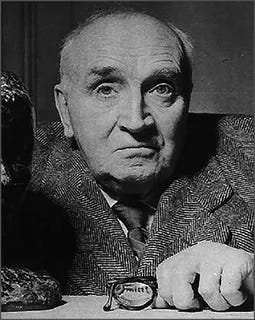
Paul Claudel
The ancient medieval cathedral became far more than a place of worship for him; it was his lifelong mentor, his silent spiritual director, and a steadfast companion, which he visited often and where he attended mass regularly, and whose stones seemed to speak to his soul,
Nearly 60 years after his conversion, Claudel wrote on December 10, 1945, to the Director of the Notre Dame Cathedral Children’s Choir School:
“For seven years, from 1886 to 1893, Notre Dame of Paris was the school where I learned everything I know and became everything I am. I will not dwell on the great event of Christmas 1886, with which you are already familiar. But the nearness of the cathedral allowed me daily to be its faithful visitor; and the Blessed Virgin, in order to force me, after a long struggle, to kiss the ground at her feet, wanted no other angels and not other ministers than her little white-robed servants (the children’s choir).
At least, every Lenten Friday I was able to tearfully kiss the relics of the Passion!”
Fortunately, through the grace of God, the intervention of Our Lady of Notre Dame, and the bravery of Fr. Jean Marc Fournier, Catholic Chaplain of the Paris Fire Brigade, and the firefighters, the precious Crown of Thorns, the relics of Our Lord’s Passion were rescued during the 2019 fire and can be venerated again during Lent at the restored Notre Dame de Paris.
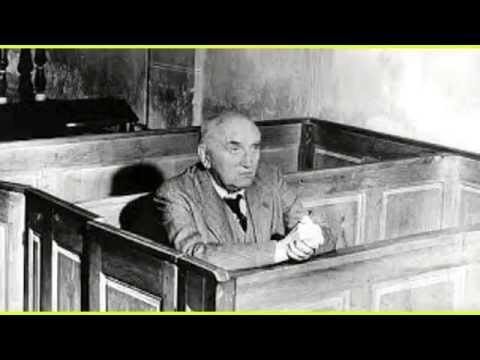
Paul Claudel at prayer
Paul Claudel enjoyed a highly prestigious career as a world renown diplomat, playwright and poet. As a result of his Notre Dame conversion, he practiced a lifelong daily spiritual routine which included morning mass, rosary, adoration, and vespers.
What secret of “eternal innocence” did Notre Dame whisper into the soul of Paul Claudel? What might that ancient Gothic sanctuary teach us about recovering the innocence that our secular age has forgotten and scorns? Claudel, the man of lettres captures the essence of his conversion:
“The Great Book open to me and in which I studied was the Church! Praised be forever that great and noble Mother at whose knees I learned everything I know! I spent all my Sundays at Notre-Dame, and stopped there as often as possible during the week. It was no long the poor language of devotional books, but the deepest and greatest poetry, the most august gestures ever entrusted to human beings.
The sight of the mass was an endless source of inspiration to me, and each of the priest’s movements etched itself deeply into my mind and heart. Little by little, slowly and laboriously, there took shape in my heart the idea that art and poetry were also divine, and that the pleasures of the flesh, far from being necessary to these great pursuits, are actually detrimental to them.”
What happened to Paul Claudel during that December dusk in Notre Dame? Was it merely what he heard—or did the entire cathedral seem to speak to him? Did all his senses converge upon that extraordinary moment: the incense hanging in the nave, the ancient stone rising around him, the stained glass rose windows filtering the evening light, the organ and the voices filling the vastness above? Was this the “symphony of stone” that Victor Hugo so memorably evoked—a cathedral whose architecture seemed not merely to surround the soul, but to possess it?
Or was something far more mysterious taking place?
Did Claudel enter that rarefied air of the Gothic nave as a skeptic and emerge from it confronted by something he could neither explain nor escape? What his intellect had resisted, beauty made suddenly impossible to ignore. Could the mystery of Claudel’s conversion lie in a Cathedral that overwhelmed him.
Was this, then the secret language of Notre Dame: a language spoken not to the mind but to the senses, the imagination, and finally to the soul?
What did Claudel hear in that music that the rest of us have forgotten to hear?
Did the innocent voices of the children’s choir pierce through the defenses of a young man who had rejected faith, transporting him—if only for an instant beyond the visible world into the presence of the divine?
Was it the purity and luminosity of the innocent voices of children which filled the cathedral that touched the heart and soul of Claudel and initiated his conversion? Did the humble and enchanting lyrics of The Canticle of Mary, her Magnificat jolt the cynical intellectual from his skepticism?
The very cathedral, that more than a century later, would stand blackened and consumed by a raging fire first burned the fire of faith into an agnostic 19th century teenager. Paul Claudel’s soul was set ablaze and restored to him as the innocence of a child of God. For the rest of his long life, he spoke and wrote about his Notre Dame conversion. He was forever a changed man.
However unusual Claudel’s conversion experience, it serves as an uplifting tale for a world racked by secularism and godless pursuits. Like so many modern agnostics, Claudel was searching for answers, for truth, and for peace in a world of cold chaos and empty nihilism.
Paul Claudel, Catholic, father, husband, diplomat, poet, playwright died On Monday, February 23, 1955. His body was brought to his beloved Notre Dame Cathedral and placed near the pillar where he had found his conversion to the Catholic faith. During the funeral, his much loved Magnificat was sung by the children’s choir-the one first heard by Claudel on Christmas Day, 1886. Claudel loved the innocent voices of the children’s choir and loved to hear the choir almost every Sunday when he was in Paris. The eulogy was delivered by the French Minister of Education, Jean Berthoin, who captured the love and admiration of the French people for Paul Claudel and his love of Notre Dame:
“Between Earth and Heaven, Paul Claudel built a kind of cathedral with unshakable buttresses whose spires, although soaring out of sight, always remain accessible to a movement of the heart. As long as there are men who suffer and hope, they will all meet, be they believers or not, in this sanctuary of invigorating poetry, there to meditated on this eternal truth: every soul which rises, raises the world with it.”
On April 15, 2019, despite a conflagration of epic proportions, the buttresses of Notre Dame Cathedral held strong and steady among the roaring flames and the gusts of wind. It was nothing short of a miracle. Also, the marble plaque marking the spot of Paul Claudel’s conversion survived the fire still rests near Our Lady’s statue in the restored Notre Dame Cathedral.
The magnificent Cathedral has been restored—its roof rebuilt, its treasures recovered, its great organ once again filling the nave with music. The stones have been raised from the ashes. The wounds have been repaired. Notre Dame stands again. Yet one haunting question remains amid the ashes of what was lost:
Can the faith that originally built Notre Dame also be restored and reborn?
Can a civilization that has forgotten the meaning of innocence recover what it once knew instinctively—the eternal innocence of childhood, the sacredness of the human person, and the transcendent beauty that points beyond this world?
The cathedral has been rebuilt. Yet, the lingering question is whether Christian civilization can be rebuilt?
The final eulogy delivered at Claudel’s burial plot by his friend, Jean-Louis Barrault provides a pathway:
“In Paul Claudel, there was never a break between earthly reality and the mystery of God. God and the little grain of sand are closely connected, they hold one another by the hand. Your works are a deep nest in which already three generations have found a haven.
Priest and poet have comparable vocations since they bring forth the life giving sap out of the sterility of materialism. Your work is that of a young man. You enlisted in the army of your church without losing any of your lucidity, of your innovating and indeed revolutionary nature.
Does a fire still burn in our civilization for the innocence of childhood?
Will our Cathedrals once again become places of divine worship, rather than art museums and stages for rock concerts?
Will they continue to burn and end up in a pile of ashes and be hollowed out?