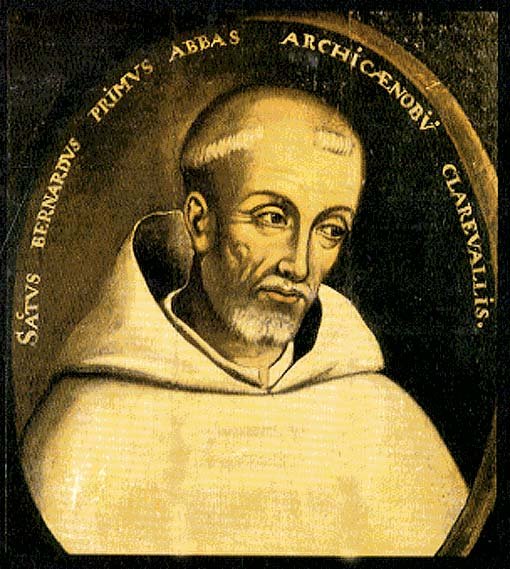
Thanks to Professor Corrado Gnerre, who quoted Saint Bernard of Clairvaux, I discovered an exceptional document.
Letters from this same saint, by which he strongly attacked the antipope Anaclet II in Rome, while defending the canonical legitimacy of Innocent II: Letter 126, to William, Duke of Aquitaine, and Letter 124, where Saint Bernard says incredible things, incredibly similar to the situation that occurred with the usurpation of the papacy in 2013.
Let's start with Letter 124:
« To all the venerable brothers, bishops and abbots, and to all the faithful of Christ in the province of Aquitaine, Bernard, Abbot of Clairvaux, sends greeting and peace, which surpasses all understanding. I cannot remain silent in the face of the danger to the Bride of Christ, nor hide the pain felt by all the children of the Church at seeing the Lord's tunic torn. Who does not weep to see the Church, our common mother, divided by an iniquitous faction? Pietro Pierleoni, who has invaded the apostolic see, did not enter through the door of the sheepfold, but climbed up by another way, behaving not as a shepherd, but as a thief and a robber. Confident in the strength of his riches and in the pride of his heart, he has set up his throne against the Church of God. But who is he, if not the man of sin, who exalts himself above all that is called God or is an object of worship? He does not seek the glory of Jesus Christ, but his own. »
It sounds like he is talking about Bergoglio. It's incredible.
« His works are manifest. Avarice, simony, and wicked ambition have guided his steps to this supreme see, which he profanes by his presence. »
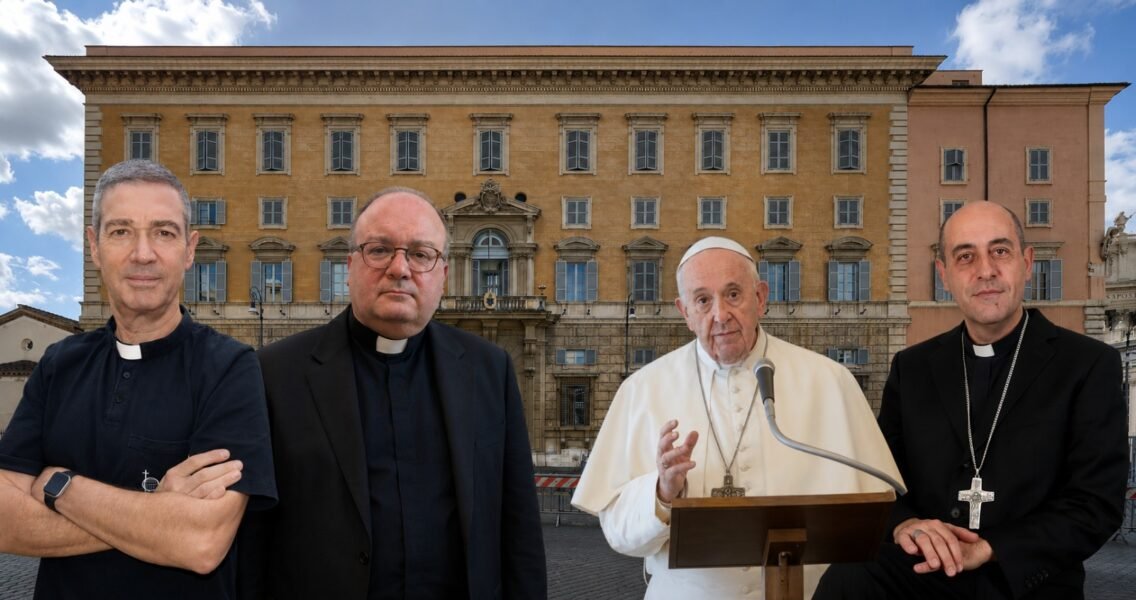
This is the photograph of Pope Francis.
« On the other side is Innocent, a man of irreproachable life, of unblemished reputation, elected by worthy men and supported by the consensus of the best. »
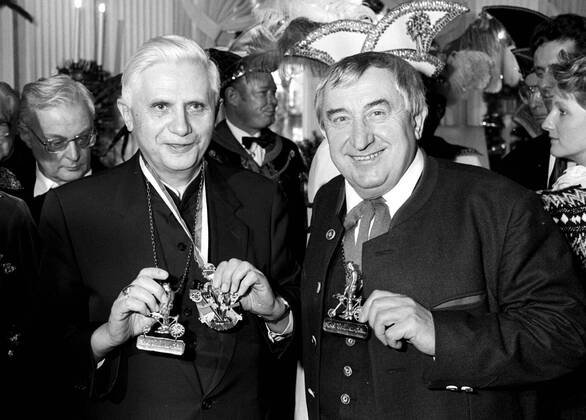
We are talking about Pope Benedict.
« He is the true successor of Peter, the one who maintains the purity of doctrine and the discipline of the ecclesiastical order. »
Again, Pope Ratzinger.
« Do not be deceived by the fables of seducers, nor by the treasures accumulated by fraud and plunder, with which this one, Anaclet, tries to buy souls. Whoever adheres to Pietro Pierleoni separates himself from the body of Christ, which is the Church. Whoever communicates with the schismatic makes himself an accomplice in his ruin. »
Incredible. He even talks about the Una Cum:
« Whoever communicates with the schismatic makes himself an accomplice in his ruin. There can be no communion between light and darkness, nor between Christ and Belial. Come out from among them, dearest brothers, and separate yourselves from this diabolical schism. Keep the peace and concord in the Holy Catholic Church, and do not allow the flock entrusted to you to be devoured by this rapacious wolf. »
Incredible. He also talks about a wolf, just as Benedict XVI did in his warning, asking to pray that he would not flee before the wolves. Saint Bernard defines Anaclet as a rapacious wolf, like the wolves Benedict had spoken of and before whom he must not flee.
« May the Lord Jesus, who promises to remain with His Church until the end of time, keep you in the true faith and in the unity of the Spirit, through the bond of peace. »
This letter, 124, tells us what a saint must do: warn everyone against the antipope, against the schismatic. You must not be in communion with the schismatic; you must not be in communion with this evil individual, who is a rapacious wolf.
Pierleoni had conquered the throne of Peter with the support of the powerful noble families of Rome and the money of his own family. He was of Jewish origin and therefore had incredible wealth, which he used to buy ecclesiastical offices, etc.
But the fundamental point is found in Letter 126, still addressed to William, Duke of Aquitaine, because in this letter Saint Bernard does not limit himself to highlighting the difference between the holiness of Innocent II and the moral corruption of Anaclet; he gets to the heart of the canonical question and says:
« Consider the form of the election, consider the dignity of the persons and the priority in time. The election of Innocent is prior in time, it is carried out by the most authoritative cardinals, and it is approved by the best. The other was done in haste, in a spirit of faction and motivated by personal interests. If you examine the persons, on one side there is an irreproachable life, a honesty recognized by all; on the other, a shadow of simony and a conduct that scandalizes the Church. If you look at the canonical right — pay attention — is it not null any act accomplished by the one who tries to establish himself on a chair that is not vacant? How can the second one be legitimate, if the chair of Peter had already been attributed and consecrated according to the sacraments to the first? The one who was installed first, consecrated according to the prescribed order and recognized by the fathers of the senior pars of the clergy, is the true bishop of Rome. The other is not a successor of Peter, but a usurper. Do not therefore join your arms to the one who splits the unity of the Church and tramples underfoot the sacred canons. »
Indeed, Innocent II — that is, Gregorio Papareschi — was elected a few hours before Anaclet.
At dawn on February 14, 1130, a small group of five cardinals met in haste and elected Gregorio Papareschi, who took the name Innocent II. Anaclet's election took place late in the morning.
When the majority of the cardinals discovered the death of the pope and the election that had taken place in great secrecy, they met in the Basilica of Saint Mark, in Rome, and proclaimed Pietro Pierleoni pope, under the name of Anaclet II.
The canonical dispute placed priority at the center.
The defense position of Anaclet II claimed that he had on his side the numerical majority of the cardinal college, the support of the people, and that of the nobles of Rome. For this reason, he drove out Innocent and was first considered by many as the effective pope, remaining on the throne for eight years.
Saint Bernard and the supporters of Innocent II, on the other hand, emphasized that the election of Innocent had taken place earlier, through the agency of the higher-ranking cardinals. Thus, since a pope had already been elected, the Petrine munus had already been conferred by the Eternal Father on Innocent II. The subsequent election, although supported by the nobles, by a large part of the clergy, and by the powerful families of Rome, counted for nothing.
This is exactly what happened in 2013.
Pope Benedict XVI not having abdicated, he had therefore not renounced the Petrine munus. How could Bergoglio be legally elected if there was already a pope before him, even if impeded?
It is clear that the canonical consideration of Saint Bernard of Clairvaux — we are talking about the year 1130, when canon law was not yet as developed as it is today — is based on the criterion that there can be only one pope at a time.
The fact that the college of cardinals is complete or not does not even matter. The five authentic cardinals, moreover the most important, would probably be considered today as cardinal-bishops. You know that there were cardinal-bishops, cardinal-priests, and cardinal-deacons. The most important cardinals, probably because they had understood that Anaclet II was plotting through simony to conquer the papacy, met in haste, without waiting for the others, and elected Gregorio Papareschi, Innocent II.
Having been elected even by a small group of cardinals, Innocent II was the true pope: he had the Petrine munus and no one else could receive it as long as Innocent II remained alive.
You see how the two cases, from a canonical point of view, are absolutely superimposable.
There cannot be more than one pope at a time. The Petrine munus, once conferred, remains as long as the pope does not renounce it by renouncing the munus and abdicating, or until he dies. No one else can be pope as long as the munus is held by a previously elected pope.
The support of the media or that of the people does not matter at all, no more than the fact that Pope Francis is more likeable or more loved. What matters is canon law.
And it does not matter that the pope must be elected by the great majority of all the cardinals. It does not matter. If the cardinals meet in conclave, those who are there are there and those who are not are not.
We have often talked about it with M° Antonacci: the constitution Universi Dominici Gregis certainly grants a waiting time for the late cardinals, but then those who are there are there and those who are not are not.
It does not matter whether the college of cardinals is complete; what matters is that the pope is elected by legitimate cardinals. If this pope is elected by legitimate cardinals, he holds the munus and no one else can hold it.
These letters of Saint Bernard are incredibly modern and current. And above all, you see the holiness of Saint Bernard and his rigor on canon law.
The aspect of the holiness of life and the fact that Pierleoni was Jewish, simoniac, etc., are secondary to the priority that Innocent II had in the election by the five cardinals.
Andrea Cionci